SpaceWarp44
by Jeff Rients SpaceWarp44 plays as orthodox chess, with the following differences:Pieces
The front rank of each array is composed of five Berolina Pawns.Instead of Bishops, two Dragon Horse pieces sit next to each King. A Dragon Horse moves as a Bishop or it is allowed a single orthogonal step.
Next to the Dragon Horses sit Crooks. These pieces combine the abilities of Rook and Knight, but once a Crook has made a single Knight's-move it is demoted to a normal Rook. Castling also demotes a Crook to an orthodox Rook.
Kings may castle by moving the Rook to the space between the King and Crook, demoting the Crook to Rook, and then moving the King to occupy the Crooks starting position.
Promotion of the Berolina Pawns may be to any of the following pieces: Queen, Dragon Horse, Crook, or Knight. Each player may only have one Queen in play at a time. Also no more than two of any other piece type (other than the Berolina Pawns) may be in play. Thus if a player has both starting Crooks in play, he may not promote to a Crook. If one of these Crooks had been captured or demoted to a Rook, then promotion to a Crook is legal. Pawns must promote immediately upon reaching the far rank unless there is no piece to which they can legally promote. In such a case a Pawn must be promoted at the next available opportunity. This delayed promotion counts as a move, expending the player's turn.
Board
SpaceWarp44 is played on a special 5 x 9 board with a hole in the center and 8 special colored spaces.
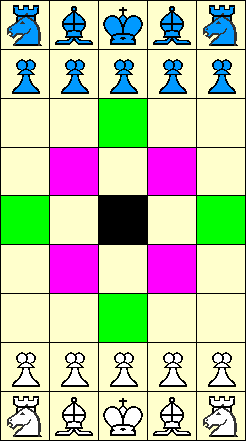
Location c5, the black square, is not a space. No piece may move through or occupy that location. Pieces are not threatened across it. Exception: A Knight's vault, such as that made by the Crook, is allowed and threatens "across" the black void of c5.
The 8 other colored squares are warpsquares, divided into 2 subsets, the purple inner warpsquares (b4, b6, d4, d6) and the green outer warpsquares (a5, c3, c7, e5). A piece on a warpsquare gains further powers in addition to their normal movement and capture abilities. A piece on an inner warpsquare may forego their normal movement and instead move to any outer warpsquare, capturing any occupying enemy piece in the process. Similarly, a piece on an outer warpsquare may move to an inner warpsquare. Pieces may only use this ability to move to a warpsquare of the other type, e.g. a move from an inner warpsquare to another inner warpsquare must utilize a pieces normal movement. A King sitting on a warpsquare is checked if an enemy piece sit on a warpsquare of the opposite type.
Additional Notes
The inspiration for SpaceWarp44 was the realization that a 5 x 9 board minus the center square could represent a black whole in space. The warp squares are meant to represent the strange things that might happen near black holes. Please note that no actual science lesson is implied. The source of inspiration was more along the lines of Star Trek rather than Stephen Hawking. This variant may be played with a set of orthodox chess pieces. Simply use the Bishops to represent Dragon Horses, orthodox Pawns for Berolina Pawns, and inverted Rooks for Crooks. Demotion from Crook to Rook is accomplished by flipping over the piece. Many thanks to David Howe for making available the great images used above.Written by Jeff Rients.
WWW page created: April 23, 2004.