Sankaku Shogi
L. Lynn Smith
Introduction
Sankaku Shogi is played on a field of forty-four triangle cells. Each player has a force of thirteen consisting of five Soldier, four Cavalry, two Chariot, one General and one Emperor. The Emperor leaps to any cell on the playing field, but may not capture an opponent Emperor which is defended. Capturing the opposing Emperor is the goal of the game. Like in the large Shogi variants, all captures are removed from play for the remainder of the game.Board and Movement
The playing field is composed of forty-four(44) triangular cells in the following pattern:
   a b c d  e f g
         __
       /\  /\
    8 /__\/__\
     /\  /\  /\
  7 /__\/__\/__\
   /\  /\  /\  /\
6 /__\/__\/__\/__\
  \  /\  /\  /\  /
 5 \/__\/__\/__\/
   /\  /\  /\  /\
4 /__\/__\/__\/__\
  \  /\  /\  /\  /
 3 \/__\/__\/__\/
    \  /\  /\  /
   2 \/__\/__\/
      \  /\  /
     1 \/__\/

a b c d e f g |
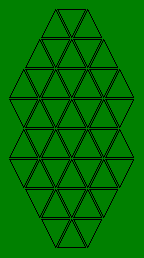
|
The following diagrams will explain the directions of movement on this playing field:
    __  __  __
  /\  /\  /\  /\
 /__\/__\/__\/__\

	or
        __
      /\  /
     /__\/
    /\  /
   /__\/
  /\  /
 /__\/

	or
  __
 \  /\
  \/__\
   \  /\
    \/__\
     \  /\
      \/__\
       \  /
        \/
Orthogonal movment is through the above patterns of triangles. With each step being from one cell to another which shares a complete side.
    __
  /\  /\
 /__\/__\
 \  /\  /
  \/__\/
Adjacent movement can be demonstrated in the above pattern. It is the translation from one cell to another which connected either by side or point. A piece in any one cell of the above pattern could adjacently move to any of the other five cells.
The Pieces
The Soldier steps one orthogonal. May capture to the second orthogonal if the first is vacant. Mandatorily promotes to General upon performing any capture. Cannot capture the Chariot.The Cavalry leaps to the second orthogonal. If this cell is occupied by a friendly piece, it performs an addition leap in any direction without returning to its starting cell. It is permitted only this one additional leap, and this second leap must be to vacant or enemy-occupied cells. Mandatorily promotes to General upon performing any capture.
The Chariot slides orthogonal. Cannot be captured by the Soldier. A Chariot can also "run down" an opponent Soldier, capturing it and continuing its slide whether to a vacant or enemy-occupied cell.
The General steps to any cell which is adjacent, whether by side or point.
The Emperor leaps to any cell on the playing field. It may not capture an opponent Emperor which is defended.
Setup
Each player has a force of thirteen in the following set-up:- Black:
- Emperor d1
- Chariot c1 e1
- Cavalry b2 c2 e2 f2
- General d2
- Soldier b3 c3 d3 e3 f3
- Chariot c1 e1
- White:
- Emperor d8
- Chariot c8 e8
- Cavalry b7 c7 e7 f7
- General d7
- Soldier b6 c6 d6 e6 f6
- Chariot c8 e8

Basic Rules
Play begins with Black.Each player must move on each turn. No passing allowed.
All captures are removed from play for the remainder of the game.
The game is won by capturing the opponent Emperor. Repetition of position merely to avoid a capture is not allowed.
Sankaku Shogi Proverbs
- The Soldier eagerly seeks to be a General.
- The Cavalry needs support for range.
- Force your opponent to draw first blood.
- An Emperor with two Generals has won the opening skirmish.
- Soldiers flee when Chariots take the field.
- Surround your opponent within their domain.
- The Emperor is both master and servant of all.
- A Soldier cannot defend the Emperor against a charging Chariot.
- The Cavalry aids the Emperor's swift escape.
- A General supports the troops, and bravely faces the enemy.
- Evade Cavalry by not standing on their ground.
- The Soldier can still support an assault on a Chariot.
Notes
I began Sankaku Shogi's creation with the intent of creating a small game with the powerful "teleporting" Emperor, a piece which is present in some of the larger Shogi variants (such as Tai Shogi). I chose the triangular cell because I was not aware of any Shogi variant that was played on this particular type of field.The original shape of the playing field was the diamond. And the two far cells were removed to limit "choke" points and create a form of first rank for each player. The two cells on each side were removed to prevent direct lines of attack on the initial position of the Emperors. This worked out to forty-four cells.
The selection of pieces was a slightly longer process. Besides the Emperor, I decided that there would be only a few others. Some would promote, some would not. For the sake of Shogi, there needed to be a General. Soldiers, or Pawns, were also a necessary. I chose the Cavalry from the game of Ko Shogi (also the look of the graphics for the Zillions implementation). And a couple of simple Chariots.
The privileges and restrictions of the pieces were worked out to encourage certain behaviour during play. For example, the inability of the Soldier to capture the Chariot and the Chariot's ability to "run down" the Soldier was to encourage the quick development and exchange of the Soldier before the Chariots could be released onto the field, and also create the potential of both positional and material advantage. In keeping with the spirit of Shogi, the promotion to General is a very welcomed occurance, since the General is able to command a large block of territory which is quite helpful in cornering the opponent's Emperor.
Unless a player makes an error, the game will end in a battle of attrition. Forcing the opponent to make that final exchange becomes similar to the end-game of XiangQi.
Written by L. Lynn Smith.
WWW page created: January 11th, 2004.