PiRaTeKnIcS
Entry for the Chessvariants 44-square competition 2004.PiRaTeKnIcS or Triadic Chess.
Authored by DTJagger. Invented by DTJagger.
Jan/Feb 2004. Copyright 2004. All rights reserved.
'PiRaTeKnIcS' or 'Triadic Chess' is an easy-to-learn 44-cell pirate-themed chess which features (among other things) multiple pieces per cell, multiple-promotions and self-capture. Each player starts with 30 crewmen (which have mostly familiar chess moves) grouped in 3's aboard 10 ships. Ships are fought over and occupied by all kinds of crew combinations as two rival pirate gangs battle it out to make their own 'kapitan' the one true pirate-king.
During the game, triads of pirate-pieces on any ship can be unmade, part-made and remade in a multitude of ways, leading to a great variety of compound pieces and tactical situations. Pieces from opposing bands can mingle on the same ship as they dispute possession with unusual consequences. Pawns can be dragged onto their own back rank. Rival kings can even come to share the same ship. Multiple pawn promotions can occur on a single move (often suddenly from distance) to transform a game.
An animated sample game gif is provided, besides notated games. (Editor's comment: Due to the large file size, I decided not to put the (over 700 Kb large) animated gif-file on the website, but instead convert it to an `avi-movie' of size around 130Kb.)
The Rules of PiRaTeKnIcS...
(FIDE chess rules apply where any uncertainty remains.)*1* Object and Outcomes:
a. The object is to 'gang-plank' (checkmate) the opponent's 'kapitan' (king).b. A player's kapitan is gang-planked if it is impossible for him legally to escape 'the blackspot' (check).
c. A game is 'in the doldrums' (stalemate) if on his move a player, though his kapitan is not currently being offered the blackspot, is unable to avoid him getting the blackspot that move.
d. A game 'in the doldrums' is a draw.
e. A draw can also occur by agreement, on threefold repetition of an overall position (with the same player to move) by either player, or after 50 turns by each player without a capture.
f. A player may resign the game.
*2* Board and Setup:
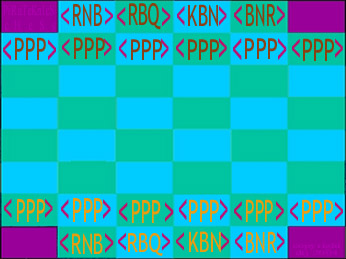
a. The board is a 6x8 grid of (large) square or rectangular cells (each cell being able to fit 3 chess pieces and a ship symbol), minus the 4 corner cells, giving 44 cells in all.b. The start position is as illustrated, showing 60 men within 20 ships.
c. For games notation purposes the files are lettered a to f, and the ranks numbered 1 to 8.
d. Diagrammatically white's start position (which black mirrors) can be represented thus:
<PPP>  <PPP>  <PPP>  <PPP>  <PPP>  <PPP>
       <RNB>  <RBQ>  <KBN>  <BNR>
*3* Pieces and Ships:
a. The various pieces (known as 'crewmen') comprise:-P - pirates, N - navigators, B - boatswains, R - roustabouts, Q - quartermasters, K - kapitans.b. Each side has 18xP, 3xN, 4xB, 3xR, 1xQ and 1xK - i.e 30 pieces fitting (by threes) into 10 ships.
c. All pieces, in their basic natural moves and captures, are equivalent to their familiar FIDE chess counterparts of pawn, knight, bishop, rook, queen, and king - (so please excuse my occasional lapses when referring to them).
d. The 20 ships can be regarded as mere containers without motive power of their own. They belong to no-one, are indestructible and can be used indiscriminately by both sides.
e. I've represented them in notation by pairs of arrow brackets e.g < > for an empty ship, < PR > for a ship holding a single white (unemboldened) pirate (i.e pawn) and a black (emboldened) roustabout (i.e rook), etc.
f. Ships can be represented in actual board play by some convenient flattish token such as a go-stone, risk-army, coin or suchlike. All should be of the same kind and colour.
g. A ship can contain up to 3 crewmen, any one of which can determine its movement.
h. Crewmen situated within the same ship are arranged in no particular order and are to be treated as positionally identical.
i. Any ship can be occupied by either side's crewmen, or even by a mixture of crewmen from both sides.
j. Crewmen situated within the same ship cannot capture one another.
k. No crewman can exist other than within a ship. One cannot remain in a cell without a ship.
l. Ships can become empty as crewmen move onto other ships.
m. An empty ship remains immobile and cannot be moved until once more occupied by a crew of at least one.
n. An empty ship, though it remains on the gameboard, presents no hindrance to any movement of ships or crew across the cell it occupies, behaving just like a completely empty cell in this respect, until it is once again crewed.
*4* Moves and Captures:
a. A player's turn consists of- either a ship move (which cannot involve a capture),
- or a crewman move (which may or may not involve a capture).
c. A pawn on its side's first rank can always move up to 3 cells forward.
d. A pawn on its side's second rank can always move up to 2 cells forward.
e. (Stated more generally, so applicable to all variants: a pawn can always move any number of spaces straight forward when moving wholly within its own half - otherwise only a single space straight forward.)
f. (A pawn still always captures 1 space diagonally forward.)
g. A pawn promotes on the end cell of any file, including the two shorter files.
h. Multiple pawns from the same ship positioned on a file end-cell will promote simultaneously, each to any other piece except pawn or king.
i. However, a pawn can never promote as a result of an opponent's move. A pawn arriving at a promotion cell due to an opponent's move remains unchanged. It could still end up being promoted properly later (i.e due to a subsequent move of the pawn by its own side again onto a promotion cell).
j. There is no 'en passant'.
k. There is no 'castling'.
l. Kings are allowed to pass through check on any move, but they must never end their own move still in check.
m. Opposing Kings may actually come to share the same ship (i.e through their accompanying a multi-step forward pawn move - see below).
n. It is however illegal for a king to be moved into the cell next to a rival king - as the kings would then be mutually checking each other.
*4.1* Ship Move:-
a. A player can move a ship to any empty cell according to the natural chess move of any of his own crewmen on that ship.b. When a player moves a ship, all the crewmen on the ship (whatever their colour) move with it. None are left behind.
c. A player cannot move a ship on which he has no crew.
d. A player cannot move an empty ship.
e. A ship move cannot capture anything.
f. A ship cannot be moved into a cell occupied by another ship whether that ship is empty or not.
g. A player's move of a ship is prohibited if it immediately undoes the effect of his opponent's last move (done with the same ship).
*4.2* Crewman Move or Capture:-
(Bear in mind that a ship can never hold more than 3 crewmen in total whatever their colour).
a. A player may move his men from one ship to another provided there is room for them. It does not matter whether the receiving ship is empty or already occupied -
and the type and colour or mix of its current occupants is immaterial.
b. A crewman may make its natural chess move (if room) or natural chess capture (by displacement) from its current ship onto any other ship which falls within range.
c. Also - if there is room to receive them - any other friendly crew from the same ship (whatever their natural chess moves) can each optionally be moved to the new ship as part of that same move, but hostile crew cannot be moved across in this way, and must remain on the original ship, which is unmoved.
d. A capture is not obligatory. A player may choose to move a man or men to another ship (if there is room) without capturing any piece - even though he might have done so.
e. Allowing the movement of friendly crewmen to another ship does not affect the position of the original ship. It stays exactly where it was, as does the receiving ship. Only friendly crew may be moved to another ship, among whom must be the crewman that initiated the move or capture.
f. Capture in any turn is always of a single crewman only and is by displacement.
g. Not just single hostile crewmen but also single friendly crewmen can be captured (and displaced).
*5* Check and checkmate:
a. Checks and checkmate apply as in FIDE chess.b. The king has potentially much greater freedom of movement to escape check, as he can be carried along by any friendly companions from within his ship. He is allowed to pass through check in his travels.
c. Similarly (but more painfully) he may be brought directly into check through the machinations of some unfriendly travelling companion on the same ship, when he is not able to exactly reverse the move which put him in peril. Only his final resting cell, though, is to be considered for check and checkmate.
d. Hurling a powerful unsupported triad immediately adjacent to an opposing king may result in him just boarding the ship himself and capturing one of his assailants. But offering twin checks from a ship at a distance (and still out of range of the king) can often be a more powerful weapon, as no- one within the ship is then capturable.
That be all the rules, me hearties!
Strategy and Tactics:
This is a game I feel I have hardly scratched the surface of. With so many pieces and combinations (392 by my reckoning) it has the feel of a bigger boardgame and lasts on average almost as long as FIDE chess. Each game played so far seems a complete novelty.The manipulation of your own and your opponent's pawns offers interesting possibilities - e.g for unblocking fixed pawn positions, for finding avenues of swift promotion for your pawns, and of course for dashing any of your opponent's naive hopes of early pawn promotion. There's a definite element of snakes and ladders to this side of things, but it requires skill to pull it off.
Already mentioned is the possibility of dragging the opponent's king into danger. In fact the dragging into and out of danger of all kinds of pieces is an important element and a major fascination of the gameplay.
It is interesting that the pawn structures of orthodox chess seem to be preserved and yet not so inflexibly - they have become permeable. Positions that look fixed can soon be unravelled, perhaps by a strategic own-pawn capture within a triad of pawns, that might then allow penetration into an opponent's haven. And of course pawns can walk straight forward onto neighbouring ships that are not already fully occupied.
Intuition is very much to the fore in PiRaTeKnIcS too. You allow checkmate to threaten in a single move because (without seeing quite clearly) you suspect you may have just about enough ammunition to keep peppering out the checks until that serendipitous 'something' emerges which will finally allow you to nail your opponent - or, if that fails, still save the day by manoevring into a position where you can manage to undermine his mate threat anyway.
Design Background:
I stumbled upon the triplet-of-pieces idea quite by accident. It had struck me that 44x3=132=(11x12), which looked interestingly squarish. Even more squarish-looking was 44x3=132=(144-12)=(12x12)-(4x3). Could I arrange triple-sized cells in a workable pattern on either of these two suggestive grids? Well, I couldn't, but by thinking of it as 44x3=132=(144-12)=((18x8)-12)=((6x3)x8)-(4x3), the related grid looked more playable. I'd arrived at a (cornerless) board of triple-cells which would serve as the basis for my final gameboard. Yet I still had no clear idea how the triple-cells would function.They soon afterwards suggested themselves, however, as simply being extended single cells to house three pieces (the 'triads'). The start layout I tried initially (which was intended somewhat to reflect orthodox chess and to retain much the same balance of piece types) I have stuck with, because, so far, it seems to play quite well. The rules of the game emerged very quickly, fully fledged, and playtesting continued to confirm their suitability.
The use of triads helps to solve the basic problem in small-board chess design of how to generate initial (and continuing) complexity. In PiRaTeKnIcS, excluding self-captures, white has 18 moves available - giving 324 positions after move 1 (compared to the 400 of ortho-chess). Including self-captures, this rockets to 47 first moves for white and around 2200 positions after move 1.
What seems to me particular unusual about PiRaTeKnIcS (though I admit nothing about it is likely to be wholly original) is the way it restrains the splintering of triads by restricting all movement to movement of ships or between ships. The ship idea serves to prevent component elements flying apart too easily and thereby diluting the essential 'composite' nature of the gameplay.
By imposing this movement restriction the density of pieces to cells can never exceed 20/44 or 0.4545 which is slightly less than the opening density of chess. With 3 captures being required to liquidate the equivalent of a triad, the game's piece density will not fall away too rapidly from that required for an interestingly complex game, providing lots of options for piece movement, not just initially, but until well into the game.
The name 'Triadic Chess' emerged first, but, as it sounded rather too formal, I paired it with 'PiRaTeKnIcS' which seemed to conjure up the lively fireworks of the gameplay, and I could even persuade myself that, besides the 'pyrotechnics' pun, there was also the suggestion that... pira-teknics=pirate-knics=pirate-konigs!=piratekings.
('Flotzilla' I spared you, but I reserve it for another time.)
Influences and Inspirations:
It is probably fair to say that most of the ideas within PiRaTeKnIcS (as with most chess variants) are part of the stock-in-trade of variant designers and are not original to the game. Even though I was not consciously imitating any other variants when I constructed the game, there are likely to have been many unconscious influences, and it was therefore hardly a surprise to me that in revisiting Pritchard's Encyclopedia of Chess afterwards, and then in ploughing through the chessvariants site itself, I came across several games sharing some of its ideas. (It might just be however that the ship idea IS original.)
Here are some variants (or references) which seem to make use of similar ideas within the general melting pot:-
Augsberg Chess - Erich Bartel (1965), Bi-place Chess - B. de Beler (1958), Double Chess III - Terrell Hill (1974), DuperChess - Jon Spencer (1972), Gregarious Chess - Bruce Trone (1986), Stacking Chess - uncredited, All-in Chess - Dr Chris Taylor (early 1970's), Free-for-all Chess - Jed Stone (1982), Nuclear Chess - Garry Crum (1967) modified by Bruce R. Trone, Ruddigore - Peter Aronson, Bicapture Chess - uncredited, Fusion Chess and Assimilation Chess - Fergus Duniho, Knightmare Chess - V.R.Parton, Combining Knightmare Chess - Peter Aronson, Bifold Halfgi - David Howe, unpublished Bifold Chess variants - David Howe and Peter Aronson, David Howe's chessvariants webpage of ideas on 'Growing and Shrinking - Playing with the size of Chess Pieces' (which discusses bifold and even threefold pieces and more) of 18 April 2001.
There could well be other even more pertinent variants, perhaps more from among the chessvariants pages, which I haven't again happened upon in this review, and maybe yet others from the world of abstract games generally. Consider any omissions on my part down to ignorance not malice. I guess in the end all I can reasonably hope for is that this package of ideas as a whole hasn't previously been put together by anybody in anything close to this form.
These books (in no particular order) have also been a general source of inspiration:-
The Encyclopedia of Chess Variants - D.B.Pritchard - Games and Puzzles Publications 1994.
The Family Book of Games - David Pritchard - Brockhampton Press 1994.
Board and Table Games from Many Civilizations - R.C.Bell - Dover Publications, Inc. 1979.
The Oxford History of Board Games - David Parlett - Oxford University Press 1999.
New Rules for Classic Games - R.Wayne Schmittberger - John Wiley and Sons, Inc. 1992.
The Way to Play - The illustrated Encyclopedia of the games of the World - by the Diagram Group - Paddington Press Ltd 1975.
A History of Chess - H.J.R.Murray - Oxford University Press 1913.
A History of Board-Games other than Chess - H.J.R.Murray - Oxford University Press 1951.
Natural Variants:
PiRaTeKnIcS comes with its own natural family of variants. Call the original "PiRaTeKnIcS (3,3)" where (3,3) represents (start, maximum) - meaning that the start position consists wholly of triads, and that each ship can hold a maximum of 3 pieces. Orthodox western chess is then rather like PiRaTeKnIcS (1,1)! One could experiment not only with straight diadic (2,2), triadic (3,3), tetradic (4,4), pentadic (5,5), hexadic (6,6) etc. chesses, but with all manner of combinations e.g (1,3), (2,3), (2,4), (3,4), (1,6), (2, no limit) etc..Though I like to think of the pure triadic (3,3) as the original, even classic version, one could perhaps experiment with a front row of just diadic pawns to start with - call it (2/3, 3), or maybe a mix of triads and diads (23/3,3), or even possibly of monads (123/3,3). Extend that idea to having diads on the back row too (123/23,3) - or even monads (123,3). Mix in the possibility (in any version) of allowing the players (given identical squads) to separately (maybe secretly) determine what their back row of triads/diads/monads consists of and where they go, and similarly with their front row of pawns if variable. Some ships (perhaps in either start row) could start empty e.g in a (0123/03,3) version.
One could add a further variable - ships could be of different crew capacities - say from 1 to 5. A ship token's type, size or colour could signal its capacity. A variant featuring ships of capacity 2, 3 or 4 could be represented in our scheme as e.g (023/03,234) etc..
Other versions might restrict the total useable squads of pieces. The starting pool of pieces could be all that is available, so promoting-pawns could only choose from among what had been captured. One could allow them to stay pawns in hope of re-promoting when there were more juicy promotion possibilities.
In the same vein, one could limit both squads to exactly 2 chess-sets worth of men. The 16 pawns per side could be initially arranged as 2 diads and 4 triads. Pawns could only promote to what was still available from the 2 sets, or what of their own side had been captured. There could never be more than 2 queens (or 4 knights, etc.) of one colour on the board.
This suggests a further variation of also allowing a 2nd king to be used, if not in the initial setup then as another piece that a pawn could promote to. The game could only be won if both kings of one colour had been captured. If a side had two kings on the board it could afford to lose one - and perhaps a pawn could promote to bring that king back too. Twin-king PiRaTeKnIcS could provide a host of interesting new possibilities. (When only one king is present, normal check and checkmate would apply. When both kings are present, check would be suspended until one of the kings had been normally captured.)
Although PiRaTeKnIcS is perfectly at home on the 44-cell board, one might easily try it (and its natural variants) on boards of other shapes and dimensions, or even try it on boards with other cell types e.g those with (elongated) hexagonal cells.
Especially when trying out PiRaTeKnIcS on larger boards, it would be tempting to introduce other piece types too - perhaps chosen from among what must be the hundreds of different piece types that occur amongst the thousands of existing chess variants. I suggest that an unpromotable omni-directional berolina pawn - call it the cannoneer (C) - might be a useful addition to the mix of pieces.
Variants could easily be developed that could be played on the usual 8x8 board. Here's one for 8x8 PiRaTeKnIcS (3,3) -
<PPP> <PPP>  <PPP>  <PPP>  <PPP> <PPP>  <PPP> <PPP>
<RRB><BNN><RBN> <QRB><KBN><RBN><BNN><RRB>
giving 24P, 7N, 8B, 7R, 1Q, 1K.
And here's another for 8x8 Twin-Kings PiRaTeKnIcS (3,3) -
<PPP>  <PPP>  <PPP> <PPP> <PPP>  <PPP> <PPP> <PPP>
<RRB><QNN><KBN><RBB><RNN><KBN><QBB><RRN>
giving 24P, 7N, 7B, 6R, 2Q, 2K. etc. etc. - you get the gist.
PiRaTeKnIcS versions could be generated for many other chess variants, and might yield interesting gameplay.
If you are piratically inclined you might prefer to use some other names for the pieces (culled from my thesaurus):
pawn=pirate/picaroon,
rook=roustabout/rapparee, and of course the biship=bo'sun could also be a buccaneer.
I very much enjoyed designing and playing PiRaTeKnIcS. Why not grab your cutlasses and give it a try?
dtj
Sample games:
Notation -
<...>	: ship
<PPR>	: ship containing 2 white pawns and a black rook
-       	: moves to
x      	: takes
P(Q)   	: pawn (which promotes to queen)
*      	: check
{*}   	: discovered check
**    	: checkmate
[**]	: threatening checkmate
?	: questionable move
!	: strong move

Examples...
b5<NRB>-a7	: Ship on b5 containing white knight, black rook and black bishop moves (as knight) to a7.
d3N-b2 		: Black knight from ship on d3 moves to ship on b2.
c8BR-f5		: Black bishop from ship on c8 (bringing along black rook) moves to ship on f5.
d3<P>-d2 *	: Ship on d3 containing black pawn moves (as pawn) to d2 giving check.
f7BR x d5P	: Black bishop from ship on f7 (bringing along black rook) takes white pawn in ship on d5.
c4QP(Q)P(N) x c1B *	: Black queen from ship on c4 (bringing along pawn that promotes to queen and
                      another pawn that promotes to knight) takes white bishop on promotion cell c1, giving
                      check.

(Ships could be dropped for sleeker notation, but are here retained for clarity.)

Sample Game One:-
[(6x8)-4] PiRaTeKnIcS (3,3): (animated gif is of this game)

	Justt Ogive		Youso Meidea
	White			Black
1) 	d2<PPP>-d4,		d7<PPP>-d5;
2)	c2<PPP>-c4,		d5P x c4P;
3)	c4P x d5P,		b7<PPP>-b5;
4)	e2<PPP>-e4,		b5P x c4P;
5)	e4P x d5P,		c7<PPP>-c5;
6)	d4P x c5P,		c5P x d4P;
7)	c5<PP>-c6,		c6P x d5P;
8)	e4P x d5P,		d4<PP>-d3;
9)	d3P x c4P;		b5P x c4P;
10)	a2<PPP>-a4,		a7<PPP>-a6;
11)	b2<PPP>-b4,		f7<PPP>-f5;
12)	f2<PPP>-f4,		f5PP x e4P;
13)	a4P x b5P,		a6PP x b5P;
14)	a4P x b5P,		b5P x a4P;
15)	d1BKN x a4P,		a6P x b5P *;
16)	a4<NBK>-c3,		c8BR-f5;
17)	b1<NRB>-a3,		e8<BNR>-f7;
18)	a3N x b5P,		b8RNB x b5N *;
19)	c3N x b5N,		f7BR x d5P;
20)	b5<NRB>-a7,		d5<RBP>-d4 *;
21)	c3B x d4B,		a7R x a3R *;
22)	c1QR x a3R,		c8<Q>-e6;
23)	a3<QBR>-a5 *,		d8NK-f7;
24)	a5R x f5R *,		f7<KNN>-e8;
25)	d4BP(Q) x a7B [**] ?,	e6Q-c4 *;
26)	c3<K>-b2,		c4QP(Q)P(N) x c1B *;
27)	b2K x c1Q,		d3<P>-d2 *;
28)	e1BRN x d2P,		c1Q x d2R *;
29)	d2<NBQ>-b3,		b3<QBN>-e3 *;
30)	e3<BNQ>-f2,		d4R-c4 *;
31)	c1<KN>-b1,		e4<PP>-e3 {*};
32)	a5Q x f5B,		b1<NK>-d2 double*;
33)	resigns.
if 33)	d2<KN>-d3,	then	d3N-b2 **;
if 33)	d2K-d1,		then	e3P(N) x f2N ** n.b capture must be of knight, not bishop;
if 33)	d2<KN>-b1, illegal move because it immediately reverses black's previous move.


Sample Game Two:-
[(6x8)-4] PiRaTeKnIcS (3,3):

	Thiso Nehas		Aselfca Pture
	White			Black
1)	e2<PPP>-e4,		d7<PPP>-d6;
2)	d2<PPP>-d4,		e7<PPP>-e5;
3)	c2<PPP>-c4,		e5P x d4P;
4)	d4P x e5P,		e5P x d4P,
5)	e5P x d6P,		c7P x d6P;
6)	f2<PPP>-f4,		c7<PP>-c5;
7)	b2<PPP>-b4,		b7<PPP>-b6;
8)	b4<PPP>-b5,		f7<PPP>-f5;
9)	e4P x f5P,		f5P x e4P;
10)	e4P x f5P,		e4<P>-e3;
11)	b1<BNR>-d3,		c8B x f5P;
12)	d3B x f5B,		c8Q x f5B;
13)	a2<PPP>-a4,		c8R-c5;
14)	d3N x c5R,		d6P x c5N;
15)	e1<RBN>-e2,		a7<PPP>-a5;
16)	c1<QRB>-c2,		e8<RBN>-e4;
17)	d1<NKB>-b2,		e4<NBR>-c3 *;
18)	d3R x c3B,		d4P x c3R *;
19)	b2B x c3P,		c3R x c2Q *;
20)	e2R x c2R,		f5<QP>-d7;
21)	e2N x c3N,		d4P x c3N *;
22)	c2R x c3P,		b8NB x d7P;
23)	c3RB x e3P,		d7<NQB>-f6 *;
24)	c2RB-c3,		f6BN x c3B *;
25)	b2NK-d3,		c3NB x e2B *;
26)	d3KN x e2N,		e2<BKN>-d1;
27)	d1N-b2,			d8B-f6;
28)	b2N x d1B,		f6B x c3R;
29)	d1N x c3B,		d8<KN>-c7;
30)	c3N-d5 *,		c7N x d5N;
31)	c4P x d5N,		b8<R>-b7;
32)	d1K-c2,  		b7<R>-a7;
33)	e3<RB>-e4, 		a7R x b5 own P;
34)	c2K-b3,			a4R x a3P;
35)	b3K x a3R,		f6<Q>-c3 [**];
36)	e4<RB>-e7 *,		c7K x b6 own P;
37)	e7BR x d6P *,		b6<KPP>-b7;
38)	d6<RBP>-c6 *,		b7<KPP>-b8;
39)	c6<RBP>-b6 *,		b8KP-c8;
40)	b6R x b5 own P,	c3Q-c4P *;
41)	a4<KPP>-a3,		c4Q x f4P;
42)	b5R x b6P,		f4Q  x c4P;
43)	b6BR x a5P ??,		c4Q x c5 own P *;
44)	a3KP-b2,		c5<QP(Q)P(N)>-f2 *;
if 45)	b2KP-c3, 	then	f2QN-b2 **;
if 45) 	b2KP-c1, 	then	f2NQ-d3 **;
45)	a5<BRP>-d2,		f2Q  x d2R *;
46)	b2KP-b3,		f2<QN>-c5 **.
or 46)				f2QN-d4 **.


Sample Game Three:-
[(6x8)-4] PiRaTeKnIcS (3,3):

	Anot Herdra		Wno Utwar
	White			Black
1)	b2<PPP>-b4,		d7<PPP>-d5;
2)	b1<RNB>-b3,		c7<PPP>-c6;
3)	a2<PPP>-a4,		b7<PPP>-b5;
4)	a4<PPP>-a5,		b8<NRB>-a6;
5)	d2<PPP>-d4,		f7<PPP>-f5;
6)	f2<PPP>-f4,		e8<NBR>-d6;
7)	c1B x f4 own P,		d6B x f4B;
8)	c1Q x f4B,		d6<NR>-e4 ?;
9)	f4<QP(Q)P(Q)>-b8,	c8Q x b8Q;
10)	b8<QQQ>-b6 *,		b6(QQQ)-b7;
11)	b7QQ x c8R *,		d8K x c8Q;
12)	c8Q x b7Q,		a6B x b7Q;
13)	e1<NRB>-f3,		f5<PPP>-f4;
14)	b3<RNB>-d3,		c6<PPP>-c5;
15)	c2<PPP>-c4,		a6<RN>-e6;
16)	b4P x c5P,		b5P x c4P;
17)	d3N x c5P,		c4P x d3R;
18)	e2PP x d3P,		e6N x c5N;
19)	c4PP x b5P,		c5N x d3B;
20)	f3R x d3N,		e4<RN>-e3 *;
21)	d3R x e3N,		e6R x e3R;
22)	c1R x c5P *,		d8<BN>-c7;
23)	d1N x e3R,		f4PP x e3N;
24)	f3BN-e2,		c7N-e6;
25)	c5R x b5P,		e6N-f4;
26)	b5RPP x b7B *,		c8K x b7P;
27)	a5<PPP>-a6 *,		b7<KRP>-c6;
28)	c6P-c7,			c8B-d7;
29)	c6R-c5 *,		c6K-d7;
30)	c5RP x c7B *,
30)			if	d7K x c7P;
then 31)	c7<RPK>-c3 *,		c3<KRP>-b2 forced;
and 32)	e2<NBP>-c3 *,		b2<KRP>-a3 forced;
and 33)	a3R x c3 own P **.
30)				d7K x c7R;
31)	c7<P(Q)P(Q)K>-c8,	e3RP x d3P *;
32)	e2B x d3R,		e3P-e2 *;
33)	d3B x e2P,		d3P x e2N *;
34)	d1B x e2P,		d7B x c8Q;
35)	e2BB-d1,		f4NP x e2P *;
36)	d1B x e2P,		e2N x d4P;
37)	e2B-d3,			c8B-e6;
38)	c8<QK>-c3,		e6B x d5 own P;
39)	d3BP-c4,		d5BPP-f3 *;
40)	d1B x f3B,		f3P(Q)P(N)B-f2 *;
41)	d1K-c1 forced,		f2<QNB>-c2 *;
42)	c3Q x c2Q *,		d4N xc2Q;
43) 	c4<BP(Q)>-f7,		c2NN x d4P;
44)	f7<QB>-a2,		d4N x c2B;
45)	a2Q x a6 own P,	c3K x d4P;
46)	a6<QP(Q)P(N)>-c8,	d4KN-d3 *;
47)	c1<K>-b1,		c1<N>-a3 *;
48)	b1K-a2 forced,		d3NK x b4P *;
49)	a2BK-e6,		a7<PPP>-a5;
50)	c8QQN-c5 *,		b4K-a3;
51)	c5QN-c3 **.

an alternative play:
33)	d3B x e2P,		d3P x e2B * ?;
34)	d1B x e2P,		d7B x c8Q;
35)	e2N x f4N,		c8<KBQ>-c7;
36)	c7Q-c1 *,		c7K-d7;
37)	c4N x d5P,		c7<B>-d6;
38)	e2B-d3,			e7PP-e6;
39)	d5N x f4P;		d7K-d6;
40)	d3B x a6 own P,	d6KB x b4P;
41)	a6<BP(Q)P(N)>-c8,
if				a7<PPP>-a5;
42)	c8QBN-c5 **.
41)				b4<KBP>-a4 *;
42)	c8<QBN>-c1 *,		a4<KBP>-e8 (pawn cannot promote);
43)	c2QBN-c6 *,		e8<KBP>-f7 (pawn cannot promote);
44)	c6<QBN>-e8 **.
Final remark
Can PiRaTeKnIcS be 'Zillioned' or 'Couriered'? Any attempts would be much appreciated.Animated game
You can download an animated game. This is an AVI-file of size around 130 kB; with a proper plugin, your browser can show this animated game to you.Written by David Jagger. Html by Hans Bodlaender.
Webpage created: May 4, 2004.