Modern Kamil
by Nuno Cruz
In Memory of the Thousand Years of Arabic Chess Tradition
Background
One of the oldest pieces (older then the Queen!), the Camel first appeared in the 14th century large variant called Tamerlane Chess. It has also been used in some modern chess variants, for example the superb Wildbeest Chess.But the Camel is also often described as being an awkward and difficult piece to use. Since it is a colorbound piece with such an elongated move, it can be very tricky to play; although one great advantage of the Camel, is that it can attack behind pawns without being threatened! But of course, the idea for this game comes from an ideal, and not from practical play. There are better pieces with which to make a playable decimal variant. But why not add to chess a piece with a tradition going back centries? This game is the ultimate version of an idea that's been punching my mind for a while! :-)
Development
In my quest to insert the Camel into an acceptable opening setup, I turned myself to the Arabic Shatranj Kamil (Perfect Chess) formula. But soon realized that it would be a little bit difficult . . . The final array I came up with has all the pawns protected at the start. Some other attempts at adding Camels to the standard array, such as Mephisto and Mexican Chess, have undefended Pawns.Rules
Modern Kamil is played - as was its predecessors a thousand years ago - on a decimal board. Square a1 is black, and the pieces are positioned as shown below:
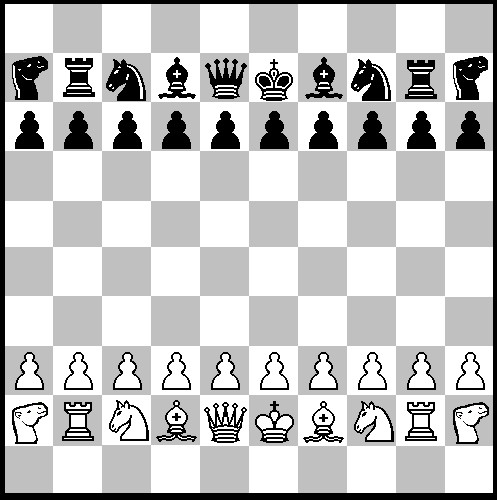
White:The rules of Standard Chess are followed, including castling, the en passant capture of the Pawn and the Pawn's double step on its first move. Differing from usual decimal variants, Pawn promotion occurs upon reaching the eight row (the row on which the opposing Pawns start), and may be to any of the usual pieces or to a Camel.Black:
- Pawns: a3 b3 c3 d3 e3 f3 g3 h3 i3 j3
- Knights: c2 h2
- Bishops: d2 g2
- Rooks: b2 i2
- Camels: a2 j2
- Queen: e2
- King: f2
- Pawns: a8 b8 c8 d8 e8 f8 g8 h8 j8 i8
- Knights: c9 h9
- Bishops: d9 g9
- Rooks: b9 i9
- Camels: a9 j9
- Queen: e9
- King: f9
Piece Movement
All the usual pieces have their normal moves.The Camel is a well known historical piece that jumps like the Knight but to a square at the opposite corner of a 2x4 rectangle (the White Camel starting on a2, could leap to d1 or b5 on the first move) . Like the Bishop, the Camel is colorbound, so it can only reach half of the squares on the board.
Self Critique
Rooks can be subjected to a ferocious Bishop attack even on the 2nd turn! Besides that, the increase in board size makes Knights less powerful. I maintained the original Chess setup in every respect, only putting an extra column and an extra row on each side, so that all opening theory is still usable and Knights possess most of the strength they have on an 8x8 board... Those who are doubtful about a decimal variant with this setup can try my other attempt at Chess with a Camel, below.Alternative Solution
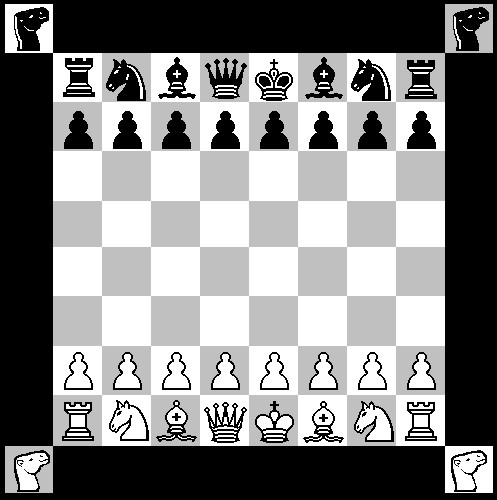
As stated above, for those who want another solution for the 'Camel problem', I came up with another variant that I named Jamal (meaning Camel in Arabic). It uses a normal 8x8 chessboard, plus four citadels placed on the corners, like in Citadel Shatranj. The Camels start on these squares. (This is the same board as used in Chess 68, and echos the treatment of the part-Camel Wizard in Omega Chess.)
All rules stay the same except stalemate, which becomes a loss for the stalemated player just like in Shatranj. This is to avoid the King moving into a citadel square where it would be impossible to defeat; but also, because I believe it is more logical then stalemate being a draw! With this, Rooks maintain their endgame power and it is possible to force mate with Knights(?). The Camels can jump directly in front of the Rook's pawns, so that most of the openings in use are not affected by them. I must confess that I also like this one, although a decimal board is much more natural...
Ending...
Which one do you like the most? Neither!? Have an idea to improve or modify any of them? Constructive criticism is always welcome! Please send me your feedback!Computer Play
A Zillions of Games Rules File with both of the above games and some other games that use Camels or Camel-like pieces is available. You can download it here:
Written by Nuno Cruz.
WWW page created: September 12th, 2002.