Piececlopedia: Camel
Historical notes
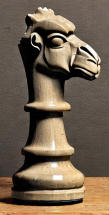
The Camel is a piece that has been used at least since the 14th century game of Tamerlane Chess. The movement of this piece — an elongated Knight's move — continues to be of interest to chess variant designers and composers of fairy chess problems today, and the piece still retains the name Camel.
Movement
The camel is a (3,1)-leaper. This means that it reaches its destination square by moving either three squares horizontally and one vertically, or one square horizontally and three vertically. For comparison, the Knight is a (2,1)-leaper. And, like the Knight, it is a jumping piece, meaning it can move to its destination square whether the intervening squares are occupied or not. If the destination square is occupied by an enemy piece, then it captures that piece.
Alternate Images
Click on an image to view the full piece set it belongs to.
 |
 |
 |
Printable Pieces
The following designs are available for printing on a 3D printer. Links are to Thingiverse.


Games
As a popular piece, The Camel is used in many chess variants. What follows is a list of many of them.
- Tamerlane Chess.
- John William Brown's Centennial Chess and Millennial Chess.
- Adrian King's Jupiter, in which it also promotes.
- John Mantle Green's Mideast Chess, where it is called the chevalier.
- Uri Bruck's Nahbi Chess.
- Tom Hartley's Napoleonic Chess, where it is called light cavalry.
- Jean-Louis Cazaux's Tamerlane II, Perfect 12, and Metamachy.
- Hans Bodlaender's Pick-the-Team Chess.
- Wayne Schmittberger's Wildebeest Chess.
- Jörg Knappen's Janus Kamil Chess.
Remarks
Like the bishop, the camel is a color-bound piece, meaning that it can only move to squares that are the same color as the one it starts on.
The Camel cannot inflict checkmate on a rectangular board with only assistance of its own King, and is thus a minor piece. Even with a pair of Camels you cannot force checkmate on a bare King, but paired with another minor this is sometimes possible. Try it!
This is an item in the Piececlopedia: an overview of different (fairy) chess pieces.
Written by Hans Bodlaender and Ben Good.
Updated by Greg Strong and H.G.Muller.
WWW page created: 1998-09-10.
WWW page updated: 2020-12-17.