Flee!
a Large Variant 99 Contest entry by Andy Kurnia
Over the years, chess has successfully remained an entertaining game for all ages. Needless to say, it is more than just a game. It is a game of skill that requires deep thoughts for a player to be able to win his opponent's royal piece while defending his own. This could be why many plays it: it models pride; or rather, dignity, in the sense that one would defend it as long as possible.
Chess has so many variants. The term chess by itself, depending on the context, always refers to a specific variant, which is generally one of orthodox chess, Chinese Chess, or Japanese Chess.
Many of the variants keep the general theme, that is, to include a royal piece to be won. However, many of these limit the movement of the royal piece to at most eight squares per move.
This variant is an attempt to demonstrate that a chess game with a
stronger royal piece, given the right circumstances, can still be
enjoyable. This piece will try to keep fleeing from enemy attacks, but
should eventually fail. [Author's note: Game has not been tested. Keep me
posted... A 16x16 board is used. It should be possible to grab four standard chess
boards and align them to simulate this big board.
Knights move FAWND.
Bishops move B.
Queens move BRAND.
Kings move BRAND. It can go through, but not to, checked squares.
Pawns move fB4fsW. It promotes on reaching the last row, to Guards only.
Guards move B4R4AND.
Where, for the unfamiliar:
R = orthogonal (rookwise) movement, any length
R4= orthogonal (rookwise) movement, up to 4th square
W = orthogonal (rookwise) movement, one square (= R1)
D = orthogonal (rookwise) jump (even over an empty square) to second square
B = diagonal (bishopwise) movement, any length
B4= diagonal (bishopwise) movement, up to 4th square
F = diagonal (bishopwise) movement, one square (= B1)
A = diagonal (bishopwise) jump (even over an empty square) to second square
N = L-shaped (knightwise) jump, 2x1
fB4 = forward-only B4
fW = forward-only W
sW = sideways-only W
fsW = fW + sW
fB4fsW = fB4 + fsW
FAWND = F + A + W + N + D
BRAND = B + R + A + N + D
B4R4AND = B4 + R4 + A + N + D
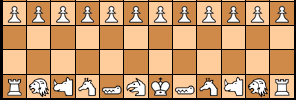
Board
Setup
Pieces
Rooks move R.
Rules
Same as standard chess unless explicitly changed as stated above.
Written by Andy Kurnia.
HTML by David Howe.
This variant is an entry in the
1999 Large Variant contest.
WWW page created: April 23, 1999. Last modified: November 14, 2002.