Bilateral Chess
By Antoine Fourrière
Introduction
A lot of players feel - rightly, in my view - that it is a pity that neither International Chess nor Chinese Chess see the confrontation of the two most enjoyable pieces, namely the Queen and the Cannon. So, they devise bigger and bigger boards. And, like in Chinese Chess, they lose the closed openings that are one of the charms of the game of Western Chess.In fact, openings are a lot of fun. Maybe learning the whole theory has become unpalatable, but why should we do away with everything? I even wish to retain the f7 weakness, and the unguarded Rooks.
The Knights aren't nearly as effective on a 10x10 board. Of the possible replacement pieces, the Camel is too awkward, and the Gnu too strong. Omega Chess does better, with its Champions and Wizards, but it doesn't feel right to end up with six short-range leapers.
As for the Cannon, why should it move Rook-wise and not Bishop-wise? To the European Chess player it looks obvious that there is no logical explanation. But can we really stomach two Chinese Cannons and two of their oblique counterparts? No? Then how about using instead the Leo? No, the Queen should keep its preeminence. For that reason, and also for the sake of symmetry, I don't wish to include Griffons, Gnus, Marshalls or Cardinals.
Moreover, on a 10x10 board, the Pawns have too much ground to cover for promotion.
And a better player than myself would find other grievances.
Board and Setup
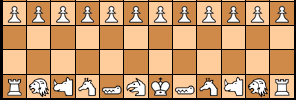
Bilateral Chess is played on a 12 x 8 board. (Yes, all chessboards are bilateral, but that one may be more bilateral than most others.) The columns are labeled y, z, a to j. (Thus, e4 retains its current meaning.)


|
|
The Pieces
The King, Queen, Rooks, Bishops, Knights and Pawns move as they do in International Chess, but there are four new pieces: the Lion, the Can(n)on, the Elephant and the Wizard.
- The Lion is of the Murray variety. It leaps two squares, orthogonally or diagonally, so it is restricted to a quarter of the board in the short term, but, captures only like the King (this differs from the standard Murray Lion which captures like a King or by its leaping move).
-
The Can(n)on is stronger than the
Pao, or Chinese Cannon, which
moves like the Rook, but hops over another piece of either side before
taking, or than the
Vao, aka Canon, which moves like
the Bishop, and hops just the same to take. But it is weaker than the
Leo (or maybe Cannnon?), which moves
and hops queenwise.
Like the Rotating Spearman from Centennial Chess, the Can(n)on is a flip piece. At the end of its move, it becomes (or stays) orthogonal or diagonal. It may also flip without moving. Since the Cannon is nearly as strong as the Rook, the Can(n)on is probably a tad stronger. However, when in h5, it will never threaten simultaneously a Rook in h8 and a King in e8, as would sometimes a Queen or a Leo.
Before its first flip, the Can(n)on is set to move Rook-wise.
- The Elephant is in no way related to the Alfil. It moves like a Wazir, one square horizontally or vertically. A two-square opening move (not necessarily in the same direction) is permitted. It doesn't capture. Still, it can push an enemy piece if the next square is available (and existing). The Elephant may be captured only by a King or a Pawn. It cannot be pushed by another Elephant or paralyzed by a Wizard. Only a friendly Can(n)on can hop over it.
-
The Wizard has overtones of
Omega Chess and
Ultima. It moves as a
Ferz, one square diagonally in any
direction. It may move two squares for its opening move, like the Pawn and the
Elephant, also not necessarily in the same direction. Thus it is more or less
colorbound. (The Elephant is of course responsible for the less.)
But there is much more to the Wizard.
To begin with, it lives in a three-dimensional world. To the Wizard, the kingside and queenside are bent against each other. So, a Wizard in a5 can walk to z4, z6, b4, b6, g5, h4, h6 and i5.
Besides, instead of moving, the Wizard can kill or paralyze.
It may capture a piece which is a Camel's ride away, that is, three squares on a orthogonal direction and one in at right angles, provided the intermediate squares are free. Our aforementioned Wizard can kill in z8 (and stay in a5) only if z6 and a7 aren't occupied.
It may freeze a piece on an adjacent square (z5, a4, a6, b5 and h5 in our above example). That piece won't move until the Wizard is taken, paralyzed, pushed, or until it moves to a non-adjacent square.
I have chosen to represent it as a Knight/Bishop. (Not only the Camel and the Firz are related to the Knight and the Bishop, but the whole picture looks very much like a hunchback wizard with his hat!)
Rules
The game is conducted by the rules of International Chess, except where noted otherwise. Castling is unaffected.A Pawn may promote into one of the four new pieces. If an adverse Elephant pushes a Pawn to promotion, it is the owner of the Elephant who chooses how to promote it. (I would bet on an Elephant rather than on a Queen.)
The Play of the Game
- The (yet untested) game becomes slightly more tactical than International Chess. However, the Elephant, the Wizard and to a lesser degree the Lion are slow pieces. Besides, the Can(n)on cannot enter the 64 central squares without an Elephant move or a flip. So, my guess is that the classical openings should survive, though not up to the twentieth move.
- The Can(n)on is stronger than the Rook after a couple of minor pieces have been exchanged, but it becomes very weak in the end. (Still, King, Lion and Can(n)on or Knight force mate, while King, Lion and bad Bishop gives a sanctuary.)
- Should the Wizard be stripped of its way of killing, or simply the lack of Camels prove unbearable, I would add the four Omega Chess corner squares, but with an extra rule: when the opposing King crosses the entire board to reach the 8th rank, those corner squares are destroyed with the pieces who are still lurking there. (Thus the King would sometimes mate its entrapped opponent simply by reaching the 7th rank.)
Notation
Pz1/ means that the Can(n)on was a Pao (moves on Rook-lines) and shifts to a Vao (moves on Bishop-lines), whether it was already in z1 or not. Vxe5 means the Can(n)on takes diagonally in e5 and remains a Vao. (Otherwise, it would be Vxe5/.)Exg3 means that the Elephant has gone in g3 to push a piece.
Wxd6 means that the Wizard has killed or paralyzed a piece in d6. (The spell depends of their relative positions. If the two Wizards are still in play, it will often be necessary to specify the Wizard's column.)
L means Lion, of course.
Written by Antoine Fourrière.
WWW page created: September 14th, 2002.