Earthquake Chess
INDEX:- Basic Premise
- Formal Rules
- More Explanations, With Pictures
- Notation
- The Rule of the Void
- Discussion of Specific Displacements
- Aftershock
- Earthquake Boards
Basic Premise
In order to play Earthquake Chess the right way, you must- Get a folding chessboard and cut it in half, so that each player has his own 8x4 half-board,
- Set up the board and pieces in the middle of Camino Real, in Cupertino California, so that each half-board is on its own side of the San Andreas Fault,
- Wait until an earthquake moves the half-boards so that they are no longer directly opposed,
- Start the game.
However
Because most of us are not fortunate enough to live right in the middle of such a convenient earthquake zone (and because those who are may not wish to play in the middle of a busy highway), it is suggested that you move the half-boards yourself. It takes little strength.Clarification
Of course, what we are describing here is not just Earthquake Chess, but the Earthquake Chessboard. You can use this same idea in any chess variant from Billiards-Shatranj to Progressive-Shogi, and in fact you can use an Earthquake Board for almost any board game, for example checkers or Stratego.Earthquake Chess is a very simple example, where the Earthquake Board is used to play with the ordinary, everyday rules of modern western orthodox chess (FIDE Chess, as we'll call it).
Because you can use the Earthquake Board with so many other games, and because there are so many different possible displacements for the two half-boards, the invention of this board has *multiplied* the number of existing games by some large number!
Note: one of the few games that cannot use the Earthquake Board is Chess for any number of players. However, for this game, the half-boards are quite useful!
Formal Rules
For the purists, here are the rules of Earthquake Chess in "legal" form:- The rules of Earthquake Chess are the same as the rules of FIDE chess, with the following exceptions:
- The Earthquake Chessboard is used instead of the normal one. (This is the only exception.)
- The Earthquake Chessboard is the same as the FIDE Chessboard except as follows:
- The Earthquake Chessboard is made up of two half-boards, which can be created by splitting a normal board horizontally in half (between the 4th rank and the 5th rank of an 8x8 chessboard).
- One of the half-boards is displaced some number of squares vertically and/or horizontally with respct to the other half-board.
More Explanations, With Pictures
ASCII pictures, of course. Here's a picture of a normal board, well, no, that would be too big.Here's a picture of a "normal" small (4x4) board:
  +====+====+====+====+
  ! a4 | b4 | c4 | d4 !
  +----+----+----+----+
  ! a3 | b3 | c3 | d3 !
  +----+----+----+----+
  ! a2 | b2 | c2 | d2 !
  +----+----+----+----+
  ! a1 | b1 | c1 | d1 !
  +====+====+====+====+
Here's a picture of an Earthquake board with no displacement:
  +====+====+====+====+
  ! a4 | b4 | c4 | d4 !
  +----+----+----+----+
  ! a3 | b3 | c3 | d3 !
  +====+====+====+====+
  ! a2 | b2 | c2 | d2 !
  +----+----+----+----+
  ! a1 | b1 | c1 | d1 !
  +====+====+====+====+
And here's a picture of an Earthquake board with the bottom half displaced by +1 horizontally:
  +====+====+====+====+
  ! a4 | b4 | c4 | d4 !
  +----+----+----+----+
  ! a3 | b3 | c3 | d3 !
  +====+====+====+====+====+
       ! a2 | b2 | c2 | d2 !
       +----+----+----+----+
       ! a1 | b1 | c1 | d1 !
       +====+====+====+====+
Get the idea? You still have the same number of squares, but the
shape of the board is a bit different.
Notation
Notation is important, because people like to be able to write down the moves they made and think about them afterwards, and talk about them, and so on.
Notation for the Board
In order to have a short way of describing each possible configuration of an Earthquake board, we can simply use the (x,y) by which the bottom half of the board is displaced; the example just above this would be a (1,0) board.
Notation for the Squares
Look at the example above. Does it seem right that a Rook on a1 can go to a2, and from a2 to b3 and b4? But wouldn't it be even worse to have your lower-left corner called "b1" instead of "a1"?Worst of all, on a full-sized Earthquake Chessboard, you can go up to "ijklmnop": not all of these letters in everybody's alphabet, I think, which makes them hard to remember, but even then how many chessplayers can visualize where "m4" is in relation to "h5"?
On the other hand, when you play with a displacement of (8,4), the square to the left of a1 would be h5. Ouch!
A counter-argument is that when you play with a displacement of (8,4), and White begins with "1. a2-a3", it is clear that the threatened move "2. a3:h8" would promote the Pawn to Q, but that the move "2. a3-a4" does *not* threaten to promote the Pawn.
I'm going to vote for "natural" notation, where the name "a8" is written on a square, and moving the other half-board to put "e1" due South of "a8" does not change its name.
The Rule of the Void
  +====+====+====+====+
  ! a4 | b4 | c4 | d4 !
  +----+----+----+----+
  ! a3 | b3 | c3 | d3 !
  +====+====+====+====+====+====+
            ! a2 | b2 | c2 | d2 !
            +----+----+----+----+
            ! a1 | b1 | c1 | d1 !
            +====+====+====+====+
In the above position, can a Bishop go from a1 to a3? It is a
perfectly diagonal move, but it flies over the void; as long as it
doesn't try to stop there, why not?
As the author here, I get to declare that Bishops and Rooks may not fly over void squares, at least not in most games. I say this because I think it will be more strategically interesting to have the void block their movement.
Here is an example of why I said "in most cases":
  +====+====+====+====+
  ! a4 | b4 | c4 | d4 !
  +----+----+----+----+
  ! a3 | b3 | c3 | d3 !
  +====+====+====+====+

  +====+====+====+====+
  ! a2 | b2 | c2 | d2 !
  +----+----+----+----+
  ! a1 | b1 | c1 | d1 !
  +====+====+====+====+
The picture above shows a displacement of (0,-1), and is silly when Rooks and Bishops can't fly across, but might be interesting when they can do so.
Knights can jump, of course. If you're using other armies with jumping pieces, of course all jumping pieces can jump over the void.
Discussion of Specific Displacements
Extreme Horizontal
A displacement of (8,0) or (-8,0) looks sort of like this:
  +====+====+====+====+
  ! a4 | b4 | c4 | d4 !
  +----+----+----+----+
  ! a3 | b3 | c3 | d3 !
  +====+====+====+====+====+====+====+====+
                      ! a2 | b2 | c2 | d2 !
                      +----+----+----+----+
                      ! a1 | b1 | c1 | d1 !
                      +====+====+====+====+
Not an interesting game, I'd say, but I think that (6,0) of (7,0)
are probably interesting.
Odd Horizontals
  +====+====+====+====+
  ! a4 | b4 | c4 | d4 !
  +----+----+----+----+
  ! a3 | b3 | c3 | d3 !
  +====+====+====+====+====+
       ! a2 | b2 | c2 | d2 !
       +----+----+----+----+
       ! a1 | b1 | c1 | d1 !
       +====+====+====+====+
Notice that the Bishop, in going from c1 to b2 to b3, goes from a
Black square to a White square.
Other Horizontals
Even a displacement of (1,0) or (-1,0) makes quite a difference in the game. Displacements of 3 or more radically change the meaning of "the center". Displacements of 2 or more leave at least some Pawns "stranded", highly unlikely ever to be promoted.
Vertical Only
A displacement of (0, 1) is exactly the same as playing on an 8x7 board; there's a little less space, but the same amount of power, so the games will be shorter.A displacement of (0,-1) can't be played unless you allow Rooks and Bishops (and Queens) to run across the void; even then, it won't work well because Pawns would get stuck. Otherwise, the main effect of this displacement would be to make Knight and Bishop moves that cross the center look a little bit strange.
Dual Displacements
  +====+====+====+====+
  ! a4 | b4 | c4 | d4 !
  +----+----+----+====+====+====+====+
  ! a3 | b3 | c3 ! a2 | b2 | c2 | d2 !
  +====+====+====+----+----+----+----+
                 ! a1 | b1 | c1 | d1 !
                 +====+====+====+====+
Displacements like this can be interesting, but here's a really
crazy game (more playable than it looks!):
  +====+====+====+====+====+====+====+====+
  ! a4 | b4 | c4 | d4 ! a2 | b2 | c2 | d2 !
  +----+----+----+----+----+----+----+----+
  ! a3 | b3 | c3 | d3 ! a1 | b1 | c1 | d1 !
  +====+====+====+====+====+====+====+====+
Aftershock
Aftershock is an optional rule. If you use it, at any time during the game, instead of moving a piece, a player can move the board.Probably only horizontal displacements should be permitted.
In order to keep Aftershock from getting out of hand, each player may use it only twice (or some other limited number of times, for example "once every twelve moves"), and may not use it to immediately undo an opponent's aftershock (that is, if you want to undo it you have to wait a move).
Earthquake Boards
After a big Earthquake, one of the following chessboards may be the result:


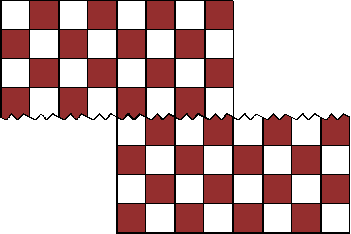
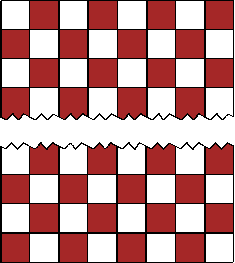
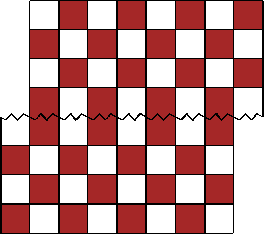
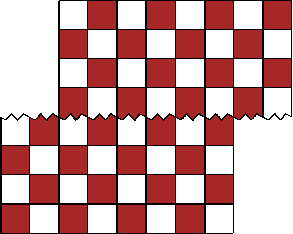

Boards drawn by Hans Bodlaender
Other Links In these Pages
- Top
- Chess with Different Armies
- Chess Variants with Different Armies
- Index to Chess Variants
- Index to Different Augmented Knights
- Index to Games of Different Augmented Knights
- About the Values of Chess Pieces
- Copyright Ralph Betza 1996
(Added by Hans Bodlaender:)
See also: Earthquake boards. Diagrams of the boards that can result of this variant.