MORE10, by Roberto Lavieri
Description
The objective of this game in a very little board 2x5 is: capture all the enemy pieces, but you can also win if the enemy repeats three times the same position. The game does not seem to be trivial, regardless the size of the board.The game has some elements of The Jungle Game, but it is different. Pieces are: UNO, DOS and TRES. After each move, the piece must be changed to another type, it is obligatory, except when reached the last line, an UNO must be changed to DOS or TRES, a DOS to UNO or TRES, a TRES to UNO or DOS, but the KING remains KING after moving.
A KING can be captured by an enemy UNO, DOS or TRES only when adjacent, these pieces can not capture the King at distance.
The UNO moves one position in every direction except diagonally backward, i.e., it can move one square vertically forward, diagonally forward, sideways, or vertically backward, and it can take only an enemy DOS or King.
The DOS leaps exactly two squares orthogonally forward. one or two squares orthogonally backward, or one square in diagonal forward direction or sideways, and it can take only an enemy TRES or KING, and it can mennace the enemy KING only when adjacent.
The TRES leaps exactly three squares in the forward orthogonal, up to three squares in the backward orthogonal direction, or one step diagonally forward or horizontally sideways, and it can capture only an enemy UNO or King, it can mennace the enemy KING only when it is adjacent to it.
UNO, DOS and TRES can promote to UNO, DOS, TRES or KING when the piece reaches the last line.
The KING can move one square in every direction, and it can capture friend pieces too. In Resume: UNO captures DOS, DOS captures TRES, TRES captures UNO, all can capture the KING, and UNO, DOS or TRES must change its type after moving.
Board and Set Up
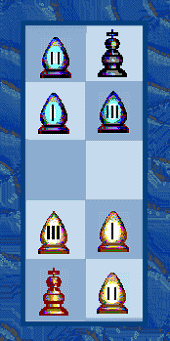
The Board is 2x5, and the setup is seen in the graphic.
White: KING in a1, DOS in b1, TRES in a2, UNO in b2
Black: KING in b5, DOS in b5, TRES in b4, UNO in a4
Computer Play
You can play MORE10 if you have installed on your Computer a Registered version of ZILLIONS OF GAMES. You can Download the MORE 10 ZRF and graphics here. (Author: Roberto Lavieri)Written by Roberto Lavieri. HTML-conversion by Hans Bodlaender. Webpage posted: February 7, 2005.