CountdownBy Jared McComb | 
|
Introduction
Far off in another galaxy, ten sects of the Dyampir race have all declared war on each other. Each on its own moon of the planet Soiuchee, the sects have come to lay claim to the planet itself but only the last one surviving will have that honor!Countdown is a game for ten people, played on ten boards of ten spaces each, with ten points worth of Icehouse pieces per player. There are some other tens involved, which will become apparent below. The goal of the game is simple: be the last sect remaining, so that you can safely colonize the planet!
Boards
The ten boards, representing colonies on the ten moons, are shown here. They can be arranged on a flat surface in any arrangement their relative positions and orientations are meaningless. Note that they are all identical except for their colors, which show who owns which moon.
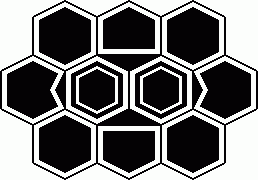
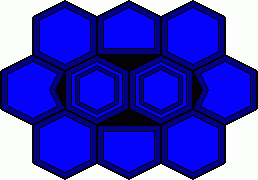
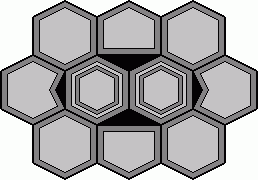
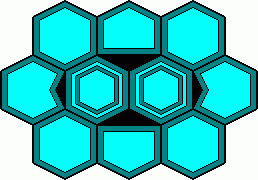
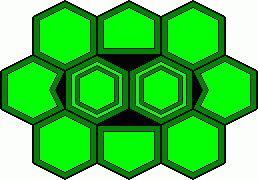
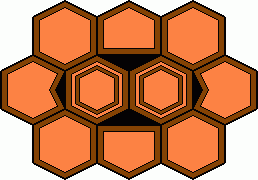
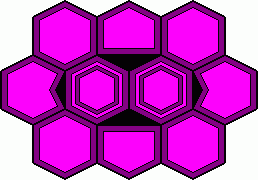
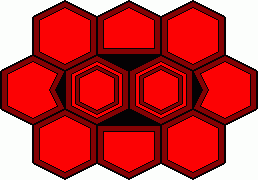
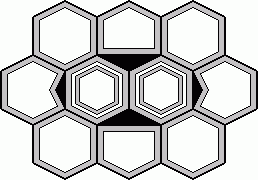
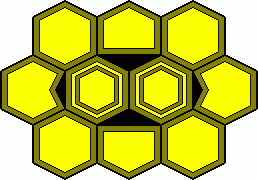
The hexagonal spaces on each board are mining colonies, with the central two being located on especially rich deposits; the pentagonal spaces are factories, and the concave heptagonal spaces are teleportation centers.
Setup
Each player (Red, Orange, Yellow, Green, Cyan, Blue, Purple, White, Black, and Clear) starts with one large pyramid, two medium pyramids, and three small pyramids, which they may initially place in any configuration on the mining colonies of their own board. (The pieces used in play will henceforth be known as Dyampirs or units (the terms will be used interchangeably), and their sizes will be referred to as ranks of Chieftain, General, and Soldier for large, medium, and small respectively.) A method of numerical tabulation, such as a piece of paper and a pencil, is also required to keep track of energies available to each player. An additional large pyramid of each color is also required to determine turn order (these are called the turn-order pyramids or TOPs).Play
Each player starts with 100 energy. As stated above, before the game starts, each player places their six pieces on the mining colonies on their board. Before each turn, place the TOPs in a bag or a hat or something and draw them out one at a time. The order in which they are drawn determines the order in which the ten players will make their moves for that turn. (It may be a good idea to stack the pyramids under each other as they are drawn.This way, the person whose TOP is on top of the stack is next to move, and after they move they can just throw the top TOP back in the bag.) As players are eliminated, their TOPs are removed from the set.
Bear in mind the difference between turn and move in these rules. The turn refers to an individual set of moves generated by the TOPs.
At the start of your move, you receive energy based on your configuration of
Dyampirs on various mining colonies. A Soldier on a mining colony can
generate 2 points of energy, a General 4 points, and a Chieftain, 6. Any
piece on a rich deposit, however, generates 1.5 times as much as they
normally would. Thus, there is a mathematical equivalent of 7 mining
colonies on each moon, although only 6 spaces are actually occupied by them.
The moon on which the mining colony is located is of no importance. Any
player may never have more than 1000 energy at any given time; any surplus
is lost.
On a normal turn, you may move a piece of yours into an adjacent space which is not already occupied by one of your pieces. If that space is occupied by an enemy piece, combat occurs. There are also ten special actions which can be used during different parts of the turn according to the action, all of which cost energy; these will be explained below. Note that the central mining colonies on each moon are not adjacent to the moons factories or teleportation centers.
Combat
Combat is resolved via rounds of Rock-Paper-Scissors-Spock-Lizard. It is interesting to additionally note that in a single match of RPSSL, there are ten outcomes which count as a win for the first player, and ten outcomes which count as a win for the second player. (There are five tying outcomes, five being half of ten.)To destroy another Dyampir, you must win a certain number of rounds of RPSSL. You must win three rounds to destroy a Chieftain, two rounds to destroy a General, and one round to destroy a Soldier. Once a piece is destroyed, the winner takes the space that was in dispute. However, combat does not necessarily always go on until one side is destroyed. If a number of ties occur, that number being equal to the number of wins required to defeat the defending Dyampir, the attacking side must retreat back to the space they attacked from. Note that some battles, such as those caused by teleporting onto another piece, must always be fought to the death.
At the end of a battle, if one side did destroy the other, the winning side receives a bonus of 10 points of energy times the number of rounds of combat they won.
Losing
You officially lose the game if you are left without a Chieftain at the end of one of your moves. If this happens, all of your pieces are immediately destroyed (although there is no bonus for anyone in this case) and all your energy goes to the player who destroyed your last Chieftain. (If you lost your last Chieftain to a Self-Destruct, all your energy is lost.) Other players can no longer teleport to your moon or harvest energy from it for the remainder of the turn.Special Actions
Each of these ten actions has different energy costs. Some can be activated in lieu of a regular move, and some can be activated at the start of or at the end of a battle. Each one has a different energy cost, all the costs being multiples of 10, and some cost different amounts depending on where the action is being used and which rank of Dyampir is using it. Different actions must be declared during the appropriate time, so for example if you do not mention that you will be using Shield just before a battle, then you cannot declare it in the middle of the battle.
Special Action #1: Teleportation
Cost: 10 points from your moon, 20 points from elsewhere
Counts as a move
You must have a unit on a teleportation center to use this. You may move
that unit to any space on any moon. If you teleport onto another unit,
combat occurs as normal, except that you cannot retreat and must fight until
you win or lose.
Special Action #2: Resistance
Cost: 20 points on your moon, 40 points elsewhere
An enemy must be attempting to teleport onto one of your units for you to
use this. You play them in an extra round of RPSSL. If you win, the
teleport is unsuccessful and their unit does not actually move. If you
lose, then their teleport is successful and combat commences. If you tie,
their teleport is successful but you have the option of moving your unit, if
possible, out of the way to an adjacent space.
Special Action #3: Shield
Cost: 10 points for a Soldier or General, 20 points for a Chieftain
You may use this just before a battle, whether you are attacking or
defending. It increases the number of rounds your opponent must win to
defeat you by one. (This also has the side effect of increasing the bonus
your opponent will receive if you lose the battle.)
Special Action #4: Extended Move
Cost: 20 points on your moon, 40 points elsewhere
You may use this before you make your regular move. The unit you are going
to move may move a total of two spaces. You may only attack on the second
space of the move. If you wish, the second move may be a teleportation.
Special Action #5: Manufacture
Cost: 20 points for a Soldier, 30 points for a General, 40 points for a
Cheiftain
Counts as a move
You may use this if you have a vacant factory on your moon and if you have
already lost a unit of the rank you are trying to build. You place the unit
on the factory.
Special Action #6: Promote
Cost: 20 points to promote by one rank, 40 points to promote by two ranks
Counts as a move
You may use this if you have lost one unit of the rank you are trying to
promote to. Replace the unit you are promoting with the previously lost
unit.
Special Action #7: Backup Plan
Cost: 10 points for a General, 30 points for a Soldier; must have at least
40 more points in reserve
You may institute one of these if your Chieftain is going into battle,
whether you are attacking or defending. Declare a unit to be the backup.
In the event that the Chieftain is destroyed, the backup is immediately
promoted to Chieftain at the additional cost of 40 points.
Special Action #8: Emergency Teleportation
Cost: 150 points
Counts as a move
You may use this if you have a unit on an enemy moon, but not on a
teleportation center. You may move the unit directly to any available space
on your moon, initiating combat if necessary. Since this is a
teleportation, any induced combat must be to the death. Any opponent you
attempt to teleport onto with this may not use Resistance.
Special Action #9: Prerogative
Cost: 80 points for the first person in a row to use, 90 points for the
second person, 100 points for the third, etc.
You may use this after the TOPs have just been drawn and if you are last in
order. You may not use this twice in one turn, although you may use it if
you end up last from someone else using it just before you. (In other
words, if someone gets out of last place with Prerogative, and you were
second-to-last just before they were successful in doing so, you may use
Prerogative as well, although it will cost you 10 more points than it did
them.) To use Prerogative, you must play a round of RPSSL with the person
at the beginning of the turn order. If you win, you may switch places in
the turn order with them; if you lose or tie, you continue on to the next
person in the turn order, and so on until you either lose to everyone or end
up switching places with someone.
Special Action #10: Self-Destruct
Cost: Nothing
You must use this at the end of the turn if you have officially lost. You
play RPSSL with each player for each unit they have on your moon. If you
win, their unit is destroyed; if you lose, they get a free Emergency
Teleportation off your moon. If you tie, play another round. If any combat
occurs from the teleportations off the moon, play it out after the moon is
vacated. Once the moon is empty, remove it from play (i.e. take the board
away). If a Self-Destruct leaves another player without a Chieftain, they
still have another move to try to regain one.
Winning
You win if, at the end of a turn and after any self-destructs (and only at the end of a turn and after any self-destructs), you are the only player remaining with a Chieftain. If, at the end of a turn, there are one or more players remaining without a Chieftain, but none of them have had a move yet and therefore have not lost yet, the game must continue until either one player is left, with a Chieftain, or no players are left at all. In the latter case, there is no winner.Variant
If you havent got 10 players or 10 Icehouse stashes, you can play with fewer. Just start with as many as you have.Credits, Etc.
This game was created for the Chess Variant Pages 10-Contest. The name Dyampir is an anagram of pyramid and the name Soiuchee is an anagram of icehouse. The game was inspired by the Looney Labs game, Cosmic Coasters. Actually, its kind of a blatant ripoff, but it uses their pyramids anyway so I guess Im okay. Incidentally, the Cyan pyramids are relatively new and can be obtained either by purchasing a boxed IceTowers set (which includes White, Purple, and Clear pyramids as well) or by purchasing a stash from their Mad Lab Rabbit-exclusive store (see their site for details on that).A quick recap of 10s in this game: there are 10 players, 10 boards, 10 spaces per board, 10 points worth of Icehouse pieces per player in play, and 10! (ten-factorial) ways that the turn order can be decided; each player starts with 102 energy and cannot accumulate more than 103; there are 10 special actions; combat is resolved in a manner which gives the attacker 10 favorable outcomes and the defender 10 favorable outcomes, and the combat victory bonus is always a multiple of 10 points; there are 10 special actions, each costing a multiple of 10 points to use; and the design of each individual board contains a 10-sided polygon in the middle, surrounded by the eight outer spaces.
You may be wondering, Why call it Countdown? Well, because there are
10 sects, each with
9 enemies, fighting over a planet with
8 letters in its name, and each having
7 deposits worth of local mining colonies, using
6
5-sided units with
4-sided bases, in
3 sizes, coming from
2 factories, towards
1 common goal: reduce the enemy forces to
0!
Written by Jared McComb. Webpage posted: May 7, 2005.