Realm Chess
Invented by Edward Jackman.
Based on movement ideas from the game REALM invented by Phil Orbanes.
Distribute freely.
Standard Realm Chess
- Standard chess setup. The board is divided up into 16 two by two realms (as in grid chess).
- During a player's turn, there are four movement choices:
- DISPERSAL: A player may move in the normal manner any number of friendly pieces from a single realm. Each piece moved must end its movement outside the realm.
- CONCENTRATION: A player may move in the normal manner up to four friendly pieces into a single realm. Each piece moved must begin its movement from outside the realm.
- REARRANGEMENT: A player may rearrange all friendly pieces within a single realm. Enemy pieces are not moved and captures cannot be made. Pieces are lifted and replaced anywhere within the realm, disregarding the individual pieces normal movement capabilities. Bishops MAY change color.
- STANDARD MOVE: Any single orthochess move. This would be the only way a piece could capture an enemy piece inside the same realm.
- All pieces move as in orthochess during dispersal and concentration. Only the king's movement is considered during castling.
- All moves during dispersal, concentration or rearrangement are considered to be simultaneous so if one or more moves give check, the rest of the moves CAN still be made. It is possible to give multiple checks (theoretical maximum is quintuple check. Not so! See here!)
- A player has the entire turn to get out of check. If and only if s/he cannot relieve check with an entire dispersal, concentration, rearrangement or standard move, then it is checkmate. A player may even move into check as long as check is relieved by the end of the turn.
- Pawns rearranged to the 1st rank may move 1, 2 or 3 squares forward.
- A pawn reaching the 8th rank by any method promotes normally.
J. Hunter Johnson notes that White may have a big advantage by being able to move four pieces into the center of the board unopposed, for example - c4, d4, Nc3, Qd3 (C-cd34). He suggests playing Balanced Realm Chess. White begins with a single move only. Black then may move up to two pieces, and so on. It is unclear how much advantage White really has at this point.
Variant Realm Chess Rules
Power Realm Chess
All rules to standard Realm Chess apply with the following major changes:
Concentration, Rearrangement and Dispersal may be combined as long as a single realm is involved. For example, on a single turn, you may move two pieces out of a realm, rearrange the two pieces remaining in that realm and finally move two other pieces into the realm, moving a total of six pieces. In fact, you may move a maximum of 8 pieces (9, if you count castling.) No piece may move more than once per turn.
Only a few games of this version have been played. The game is much wilder than the standard game. Less interesting in my opinion.
Free Realm Chess
All rules for Realm Chess apply except:
A realm is defined as any 2x2 square on the board. There are 49 possible realms instead of just the 16 in standard realm.
Only a few games played. Pawns become more mobile than in the standard game. May be better than the original, but I'm not sure yet.
Here's a Standard Realm Chess game played recently by email:
Standard Realm Chess
| Edward | Hunter | |||
| 1. | c4 d4 Nc3 Qd3 | (C-cd34) | h5 Rh6 Nf6 g5 | (D-gh78) |
| 2. | Bxg5 | Rh5 h5h6 | (R-gh56) | |
| 3. | g4 h4 Bh3 | (C-gh34) | Rg6 | (R-gh56) |
| 4. | Bg5-h5 | (R-gh56) | Rh6 h6g5 | (R-gh56) |
| 5. | hxg5 Bg2 | (D-gh34) | Rh8 Nh7 Bg7 | (C-gh78) |
| 6. | e4 f4 0-0-0 | (D-ef12) | Qc7 Bd7 c7c8 d7d8 | (R-cd78) |
| 7. | Bh3, Ne2, Re1 | (D-gh12) | a5 b5 Ra6 Nc6 | (D-ab78) |
| 8. | Pxb5, d5, Na4, Qe3 | (D-cd34) | Nb4+ | |
| 9. | Nc3, Nd4 | (C-cd34) | BxN Nxg5 RxB | (D-gh78) |
| 10. | gxh5, Bxd7+ | (D-gh34) | KxB | |
| 11. | fxg5, Qxd4 | (D-ef34) | Qf4 Ke8 c5+ | (D-cd78) |
| 12. | Qe3 | e5 f5 | (D-ef78) | |
| 13. | Qxf4 | resign |
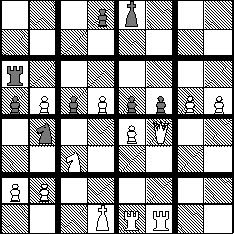 White:
King d1; Queen f4; Rook e1, f1; Knight c3; Pawn a2, b2, b5, d5, e4, g5,
h5.
Black:
King e8; Rook a6; Knight b4; Pawn a5, c5, d8, e5, f5.
[Helge Blohmer writes in March 2000:
It is not!!! Using a concentration move, it is perfectly possible to have a sextuple check in Realm Chess (after promoting a pawn at some time ...)Position:
W: Ke1, Qa7, Qd2, Rb6, Rh7, Ba5, Nb7, Ne7
B: Kc7Move: concentrating on the c5-c6-d5-d6 realm, I move: Nc5, Nd5, Rc6, Qd6 ++++++.
Result: I check via Qa7, Rc6, Ba5, Nd5, Rh7, Qd6 (oh, and it's mate as well ;-) ]
[Helge Blohmer writes again in September 2002:
Well, let's see. I can create four discovered checks and three direct checks (simple logic dictates there can never be four direct checks). I'll again need a promoted pawn somewhere in order to get my third knight:White: Kh1 Qg8 Rd1 Rh5 Ba2 Nc4 Ne5 Ne6 Pd3
Black: Kd5 Qe4White concentrates to e3-e4-f3-f4:
Pd3xe4
Nc4-e3
Ne5-f3
Ne6-f4Checks:
(1) Discovered rook d1
(2) Discovered bishop a1
(3) Discovered queen g8
(4) Discovered rook h5
(5) Direct pawn e4
(6) Direct knight e3
(7) Direct knight f4
Not even mate, either - Kxe4 answers all seven checks!Unless I overlooked something, it looks like I indeed found the septuple...
Note: I could use a Bishop d3 as well, but this would require a second promoted pawn, so using the pawn is more elegant. ]
Written by Edward Jackman
Last modified: March 13, 2000.