Fusion Diamond 41
Fusion Diamond 41 is a Fusion Chess variant on a 41 square diamond shaped board. The idea for a diamond shaped board was borrowed from Diamond Chess by Bruce Mills. Fusion Diamond 41 was created by Fergus Duniho, the creator of Fusion Chess, as an entry in the 41 Squares Contest. Many small Chess variants are plagued by congestion. It becomes very hard to move the pieces around. The features of Fusion Diamond 41 are designed to reduce congestion. The shape of the board covers where most of the action would be on a 9x9 board. The Berolina Pawns work better on a diamond shaped board, and their greater mobility lets them get out of the way more easily. The ability to join and split pieces provides pieces with more options for movement, and it also allows for an interesting variety of pieces on a small board.
Fusion Chess, which this game is based on, is a Chess variant in which pieces may merge together or split apart. In some philosophical inquiries into personal identity, fusion is the process whereby two individuals merge together as a single individual, and fission is the process whereby a single individual divides into two people. Fusion Chess borrows these concepts of fusion and fission from personal identity theory and applies them to Chess pieces.
Setup
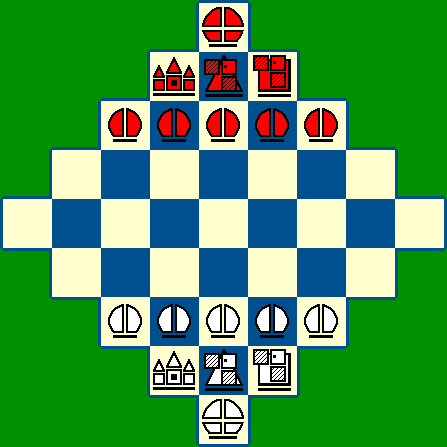
- White
- King: e1
- Queen: d2
- Paladin: e2
- Marshall: f2
- Berolina Pawn: c3, d3, e3, f3, g3
- Red
- King: e9
- Queen: d8
- Paladin: e8
- Marshall: f8
- Berolina Pawn: c7, d7, e7, f7, g7
Rules
Fusion Chess was updated in 2020, but when I entered this game into the 41 Squares Contest in 2001, it was based on the original rules of Fusion Chess. I have marked obselete rules with DEL tags and new rules with INS tags.
- A simple piece (King, Knight, Bishop, or Rook) may combine with another non-royal simple piece by moving onto its square.
- The combined piece is the piece which moves as either of the two pieces just combined.
- King + Bishop =
PopePontiff - King + Rook = Dragon King
- King + Knight =
Eques RexCavalier King - Bishop + Rook = Queen
- Bishop + Knight = Paladin
- Rook + Knight = Marshall
- A piece may not combine with another piece of the same type.
- Knight + Knight = Rook + Rook = Bishop + Bishop = Illegal.
-
A non-royal piece may not move to combine with a King, but a King may move to combine with a non-royal piece. - A King may not move to combine with another piece, but a non-royal simple piece may move to combine with a King.
- A piece may combine only with a piece belonging to the same player.
- Compound pieces may not combine with other pieces.
- An unattacked compound piece may split into its components by moving one of its components, under its own powers of movement, to an empty square.
- A Rook which separates from a piece must move away as a Rook moves.
- A Bishop which separates from a piece must move away as a Bishop moves.
- A Knight which separates from a piece must move away as a Knight moves.
- A King which separates from a piece must move away as a King moves.
- The compound piece is replaced by the component which doesn't move away.
- No royal piece may move through check when moving more than one space. For the Dragon King and Pontiff, the meaning of this is straightforward. For the Cavalier King, the Knight move is understood as beginning orthogonally and turning diagonally or vice versa. As long as it has an unchecked path to its destination, and the move does not place it in check, its Knight leap is legal. If both spaces it might pass over to reach a space are checked, it cannot move there. However, this does not limit its ability to check or attack a piece.
- There is no castling.
- Berolina Pawns are used in place of regular Pawns.
- Berolina Pawns capture straight forward and move diagonally forward.
- Pawns may not make a double move or capture en passant.
- Pawns promote on the second-to-last rank.
- Pawns may promote to Rook, Bishop, or Knight, but not to any compound piece.
- The object is to checkmate your opponent's current royal piece, which may be a King,
PopePontiff, Dragon King, orEques RexCavalier King.
Pieces
 King The King moves one space in any direction, but may not
move into check. The King is one
of four possible royal pieces which a player may have. A King may merge with a Bishop to form a Pope, with
a Rook to form a Dragon King,
or with a Knight to form an Eques Rex. If any one of these pieces gets checkmated, you lose.
|  Pope The Pope moves as a King or Bishop, but may not move into check. The Pope is a royal
piece and is formed when a King
merges with a neighboring Bishop. When the Pope is on the board, it is the player's only royal piece, and
the game is lost if it is
checkmated. The Pope may split into its components by making a non-capturing move with one of them.
|  Dragon King The Dragon King moves as a King or Rook, but may not move into check. The Dragon King
is a royal piece and is formed
when a King merges with a neighboring Rook. When the Dragon King is on the board, it is the player's only
royal piece, and the game is
lost if it is checkmated. The Dragon King may split into its components by making a non-capturing move with
one of them. The name for
this piece is borrowed from Shogi.
|  Eques Rex The Eques Rex moves as a King or Knight, but may not move into check. The Eques Rex is
a royal piece and is formed
when a King merges with a neighboring Knight. When the Eques Rex is on the board, it is the player's only
royal piece, and the game is
lost if it is checkmated. The Eques Rex may split into its components by making a non-capturing move with
one of them. The name is Latin
for Cavalier King.
|  Knight The Knight moves as the Knight in Chess, jumping in an L
shape, two spaces forward and
one to the side. A Knight may merge with a Rook to form a Marshall or with a Bishop to form a Paladin.
|  Rook The Rook moves as the Rook in Chess, any number of spaces
orthogonally. A Rook may merge
with a Knight to form a Marshall or with a Bishop to form a Queen.
|  Bishop The Bishop moves as the Bishop in Chess, any number of
spaces diagonally. A Bishop may
merge with a Knight to form a Paladin or with a Rook to form a Queen.
|  Queen The Queen moves as the Queen in Chess, any number of
spaces in any single direction.
The Queen is a combination of Rook and Bishop. It may separate into its components by moving one of them to
an empty space.
|  Marshall The Marshall moves as a Rook or Knight. The
Marshall is a combination of Rook and
Knight, and it may separate into its components by moving one of them to an empty space.
|  Paladin The Paladin moves as a Bishop or Knight. The
Paladin is a combination of Bishop
and Knight, and it may separate into its components by moving one of them to an empty space.
|  Berolina Pawn The Berolina Pawn captures by moving one space
orthogonally forward, and it moves without capturing by moving one space diagonally forward. Although the
Berolina Pawn normally has a double move, it does not in this game. There is also no en passant in this
game. When a Berolina Pawn reaches the second-to-last rank, it may promote to a Rook,
Bishop, or Knight. It may not promote to a Queen, Marshall, or Paladin.
| |
Equipment
You can play this game with the pieces from a regular Chess set, a Gothic Chess set, or a Grand Chess set. If you use a regular Chess set, you should use a pair of pieces to represent each compound piece. One regular Chess set will have all the pieces you need for this. Sets for Gothic Chess and Grand Chess come with additional pieces that represent all the non-royal compound pieces in this game. But you would still have to use pairs of pieces for the royal compound pieces.
You can make the board by tiling together poster board tiles or sections cut from a Chess board. Or you could draw the board on a sheet of paper.
Notation
Use algebraic notation as you would for Chess. Use P to denote Paladin and M to denote Marshall. Denote Berolina Pawn moves without the use of any letter to identify it. When a piece merges with another piece, follow the move with = and the abbreviation for the new piece. For example, R c4 - d4 = M indicates that a Rook moved from c4 to d4 and merged with a Knight on d4 to form a Marshall. When a piece separates from a compound piece, identify the move as belonging to the piece which moves away from the compound piece. Follow its move with a semicolon and identify what piece is left behind. For example, R c4 - d4; c4 = N indicates that a Rook separated from a Marshall at c4, moved to d4, and left behind a Knight at c4.
Play on Your Computer

If you have Zillions of Games, you can play Fusion Diamond 41 on your computer. On March 31, 2001, the zrf was updated to use the board shown on your left. Sound effects were also updated.
Written by Fergus Duniho
WWW Page Created: Sat Mar 10, 2001.