Dart 6x6 Chess
Designed by Darren Izzard
Introduction and Background
This is a game that I put together in early July 1999 as a test game for a temporal difference game-playing program I wrote, and that is how most of the play-testing has been done. However, it turned out to be quite playable (in my opinion) so here are the rules if you want to try it out!Note that there is no connection between this game and the existing chess variant "Darts Chess".
The Board Layout and Pieces
The game is played on a 6x6 board. Each player has the same basic army: one king, two knights, two rooks, one bishop, and six pawns (the underlined letters are the ones representing each piece in the ASCII diagram). Here is the layout at the start of the game:-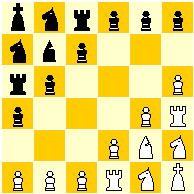 |
knrppp |
In addition, each player has three "darts". These are not placed on the board initially, but are held in reserve. See below for dart rules.
The other (standard) pieces all move in the same way as conventional chess, except for the pawns and castling.
Pawns may not move two squares from their starting rank (due to the small size of the board), and there is no en passant capture. Other than that, they move and capture just as in normal chess. A pawn may promote to a rook, knight or bishop.
There is no castling.
Dart Rules
This is what a dart looks like:-White:
 Black:
It is represented in ASCII diagrams as "d" (or "D"). Although I have provided both black and white diagrams for the dart piece, there isn't really a need to give each player's darts a different colour, because all darts behave in exactly the same way regardless of whose they are.
At the start of the game, each player has three darts in reserve. (The thinking behind this number is explained below.)
A dart may be placed on the board ("thrown") on any unoccupied square in the central 4x4 section of the board (that is, anywhere except the edges and corners). Throwing a dart counts as a move in its own right. When a player has thrown all three of his/her darts, he/she can throw no further ones. There is no way of moving or removing a dart during a game once it has been thrown.
A dart may be thrown at almost any point in the game. As with other moves, throwing a dart is disallowed if it would result in the player's own king being left in check. A dart may be thrown, however, if throwing it gets the player's king out of check.
On the board, darts neither move nor capture. They act as blocks, preventing other pieces from moving. No piece may cross or capture a dart belonging to either player.
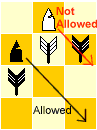
If two darts are next to each other diagonally (but not orthogonally), pieces making diagonal moves (bishops, kings, pawns making captures) may pass between them, if this is part of a legal move. Here is an illustration of this:-
Knights may not jump over darts. To clarify this, consider a knight's move in this way:-

When jumping, the knight crosses the two squares (with red dots in the diagram) between it and the destination (with a blue dot). If either or both of those two squares contains a dart, the knight is not allowed to make that move. Here are a couple of other diagrams showing where a knight can and cannot move:-
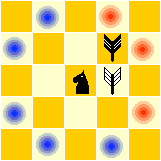 | 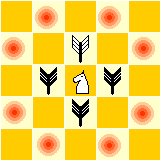 |
Notes and Strategy
The bishops tend to disappear early in the game (bear in mind, of course, that they are under attack from each other right from the starting position). One might think that, since they can pass between two diagonally placed darts, they would come into play later through promotion, but I have noticed that my computer player seems generally to promote pawns to rooks, and even when I have tried promoting my own pawns to bishops, they too seem to disappear quite rapidly. As for promoting to knights, remember how easy it is to disable a knight using darts, both offensively and defensively.Why only three darts per player? When I first designed this game, each player started with five darts, which could be placed anywhere on the board. I spotted two problems with this early on. Firstly, it was possible to completely isolate the king by surrounding it with darts. But, since darts do not capture, this did not count as check or checkmate - and, since darts cannot be crossed or removed, the game could only be declared stalemate, which was rather unsatisfactory. Secondly, it was possible to separate the board into two halves quite easily, which, if each half contained a player's king, would also result in a rather awkward stalemate. The solution the latter problem was to limit darts to the central 4x4 section of the board. The solution to the former was to lower the number of darts each player had. Since it takes eight darts to completely surround and cut off a king, I decided to only give each player three (six in total), which means such an event cannot occur.
Page written by Darren Izzard.
Page created 15th July 1999.