Vortex Chess
by Robert LeRoy
Vortex chess is a chess variant I wrote for Zillions after being highly caffeinated and kept awake for over 24 hours. :)
The setup and rules are basically the same as standard chess, but there is the inclusion of one new piece on both sides: The Portal, or Vortex. (It can be called both, because the game is called Vortex Chess, but the piece-name I put in for the vortex itself was "Portal", and I didn't notice it at the time due to my caffeinated state. :P)
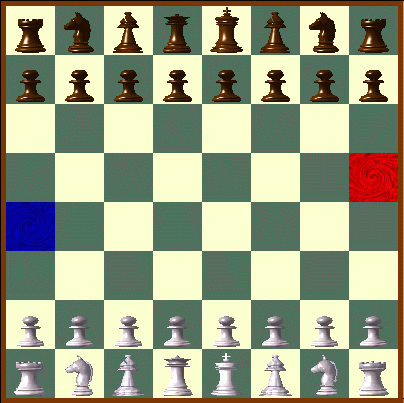
The setup is as above, with white's vortex (the blue one) on the fourth rank on the far left, and black's (the red one) on the fifth to the far right.
The effect of the vortex is as follows: Any piece that would otherwise land on the space occupied by the vortex, its path is transplanted onto the space in that same direction from the other vortex.
For example, from the opening move, the leftmost pawn of White can move to the sixth rank on the far right, because it has an opening move of two.
The movement of the vortex piece is simple - it can move to any unoccupied square. At first I thought this might make it too easy to defend a King in check, but upon seeing Zillions' response to this tactic, I realized that the portal can only defend the King if there is only one space between the King and the attacker, as the opponent can always place their portal next to yours, in effect nullifying it.
Knights take a little getting used to in Vortex Chess, depending on how you remember how they move. A Knight can leap over a portal, but if it lands on one, it moves diagonally from the other, not orthogonally, which is what a person might think if they use the L-shape movement for ease of remembering. :)
I have not included the ZRF file for this game in my submission, as I'm still going over bugs and the like, but if you want a copy, just e-mail me and I would be happy to give you a copy.
This ZRF has two variations - the default allowing movement of the portals only once every other turn, by alternating sides. The variant allowing movement of the portals during each turn by both sides.
Written by Robert LeRoy.
WWW page created: March 6, 2000.