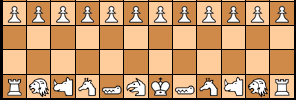
Toulousain Chess
Important notice
Toulousain chess, invented by Jean-Louis Cazaux (2003), had an entry an entry in D.B. Pritchard's book "The Classified Encyclopedia of Chess Variants" (2007). This game was a predecessor of Metamachy proposed by J.L. Cazaux in 2012 and which has replaced it.
This game is a chess variant on a red and black 12 x 12 board with 12 types of different pieces.
Setup
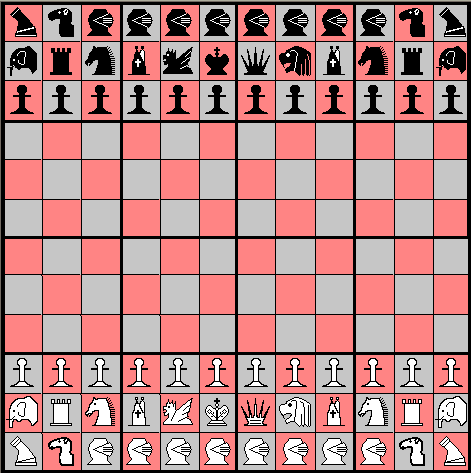
The white King is placed on the center of the second row on a black square, the black King beeing on a white (or red) square. The Queen is placed beside of the King in the center. The Gryphon is at King's side and the Lion is at Queen's side.
There are:
- 3 Supreme pieces, 1 of each: Queen, Gryphon, Lion with about the same value
- 6 Major pieces, 2 of each: Rook, Cannon, Bishop, Elephant, Knight and Camel
- 12 Pawns (augmented to take into account the large size of the board) and 8 Corporals.
Pieces
King, Queen, Bishop, Knight and Rook are orthodox.
Pawn: the Pawn is almost similar to FIDE Chess. There are two differences:
It can advance one or two square from ANY position on the board. It allows the Pawn to reach the opposite side in 5 steps which is comparable to Orthodox Chess.
However, its capturing move is unchanged: one square diagonally forward. As a consequence, the en-passant capture is possible every time an opposite Pawn (or Corporal) has advanced two square.
When the Pawn reaches the last row it can promote to one of the three major pieces: Queen, Lion or Gryphon.
Corporal: the Corporal is an improved Pawn:
It can advance one or two square from any position on the board and its capturing move is one square diagonally forward.
The improvement is that the Corporal can also advance 1 step diagonally forward. (So, with or without capturing).
The Corporal can take en-passant every time an opposite Pawn or Corporal has advanced two squares.
When the Corporal reaches the last row it promotes to one of the three major pieces: Queen, Lion or Gryphon.
Lion: the Lion is inspired (although with some simplification) by Chu Shogi, the most popular variant of the Japanese Chess. This game is also played on a 12 x 12 board and was mentioned as long ago as the twelfth century. In this game, the Lion may move as a King (a squares away, jumping in any orthogonal or diagonal direction, or alternatively jumping as a Knight in Western Chess. (Then this Lion has the same range but is more restricted than the Lion in Chu Shogi which can move 2 times in a turn).
Gryphon: this piece comes from the Grande Acedrex, which is described in one of the very first game books in Western Europe appeared in 1283, under `editorship' of the Spanish King Alphonso X. The Gryphon moves one square diagonal, followed by an arbitrary number of squares horizontal or vertical. It is authorized to go only one square diagonal. It may not jump over other pieces, and the unobstructed path must start with the diagonal movement.
Camel: a well known piece since medieval muslim great chess like Tamerlane's Chess. It jumps to the opposite case of a 2x4 rectangle, like an extended Knight. No matter what intermediate cases contain. Note that it always stays on the same color of square.
Cannon: borrowed from Xiang-Qi, the Chinese Chess. It moves like a Rook and needs an intermediate piece between itself and its victim to capture it. The Cannon jumps the intermediate and takes the victim on its square. The intermediate is left unaffected.
Elephant: it is a modern extension of the Elephant found in Shatranj. It moves 1 or 2 cases diagonally. It can jump over the first case if it is occupied. This form is also used in other games from the same author like Shako and Tamerlane II.
Rules
Castling: the King may 'castle' with the Rook if neither the Rook nor King has moved yet and there is nothing in between them. In castling the King slides 3 squares to the Rook and the Rook leaps to the far side of the King. You may not castle out of or through check, or if the King or Rook involved has previously moved
End of Game: Victory is obtained when the opposite King is checkmated.
All rules are as in orthodox Chess unless stated otherwise.
Remarks
Toulousain Chess was the successor of Perfect 12.
This game is dedicated to Toulouse, the city of South-West of France.
Written by Jean-Louis Cazaux.
WWW page created: 2003-07-09
WWW page updated: 2021-01-17