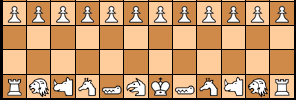
Doublewide Chess
By Ralph Betza
Doublewide Chess is a chess variant played on a large chessboard of double width, using two complete chess sets including two Kings per side.This very simple idea has quite likely been invented before, (for example, this) so I write this not to claim invention but to draw attention to several intriguing aspects of the game.
Writing the Moves
Following the conventions of Chess on a Really Big Board, the lower leftmost square of the board should be called a1.a1, and the lower rightmost square should be called b1.h1; this seems cumbersome and requires one to type more characters than other possible notations, but it is clear and unambiguous and fits in to a larger scheme of things.
Where's the Center?
On the 8x8 chessboard, there are 4 center squares, and they are extremely powerful. The center is pretty well defined by the ability of a Bishop to more or less reach any of the 4 corners in one move from a center square, and by the ability of the Kinght to attack squares in all four corner regions in one move from a center square.The 16x8 Doublewide board is not square, and therefore the four corners are Too Far to Fork. There are no center squares as powerful as those on the 8x8 board.
However, there are many center squares that allow a Knight or a Bishop to attack widely separated areas of the enemy camp. In fact, there are no less than 18 squares, from a1.d4 to b1.d5, which provide as much mobility as do the four center squares of the 8x8 board.
In Doublewide, there are twice as many pieces, and 4.5 times as many center squares; but the center squares are not quite as powerful. The large number of center squares means that it is not as easy to dominate the center, and it also means that the fight for control of the one most important central square [1] is not usually as intense as it is on the 8x8 board.
The importance of the center in the strategy of Chess cannot be underestimated. The difference in the nature of the center in Doublewide Chess means that the game is less familiar than one might expect, even though all the familiar pieces are used.
How Many Moves to Play?
More years ago than I care to think, I put forth a theory that the number of moves in a chess variant depends very much on the ratio between power and space in the initial position; if you put more power on an 8x8 board, the game will (on average) last fewer moves -- and fewer moves was good in the days when we played postal chess by snail mail. [2]In Doublewide, the ratio is the same, but there are twice as many pieces; and yes, in a closely fought and well played game, all the pieces will need to be developed and all will need to participate in attack or defense. Therefore, Doublewide Chess takes fundamentally twice as many moves to play as does FIDE Chess.
There is a mitigating factor. Each side has two Kings. The game can be won by forking the two Kings, which counts as checkmate unless both can be rescued in one move [3]. This possibility may shorten the average length of a game, perhaps by as much as ten or twenty per cent (this number is a guess, nothing more).
What Happened to Zugzwang?
With White Ka1.e6, Pa1.d6, Kb1.e1; Black Ka1.d8, Kb1.e8; White advances his Pawn and would win by zugzwang if there were only one King. Instead, Black's other King moves, and the game is a draw.In many cases, zugzwang has been eliminated by the extra King; however, when it is a factor it is all the more interesting for that, and the elimination of the stalemate defense makes Doublewide Chess just as winnable as you could want. For example, K+K+N versus K+K seems to be a win.
Two Kings
There are two Kings, and even when they Castle away from the centerline, they are not Too Far to Fork. A bishop at b1.a7 attacks both a1.c1 and b1.g8!Nimzovich said that every position has at least one weakness, the King. In Doublewide Chess every position has at least two weaknesses, and Nimzovich also describes a technique called Alternation [4], where you take advantage of an advantage in mobility by first piling up attacks on one weakness and then you switch your pieces to attack a different one (the less mobile defenders cannot switch in time). Alternation works very well in FIDE Chess, though you rarely see a position where it is appropriate. Perhaps it will be more common in Doublewide Chess.
One of the directions you can Castle actually brings your King closer to the centerline; and castling both Kings towards the center leaves them dangerously near each other, and both dangerously exposed to attacks from all directions. One may expect that sacrifices to stop Castling will be both more common and more successful in Doublewide Chess.
Almost Cylindrical
The situation along the centerline reminds me of Cylindrical Chess. So do the extended center and the fact that Bishops gain much value in both games.In Cylindrical Chess, if Black is a beginner White is expected to play 1. b2-b4, so that e7-e5?? 2. Bc1xd8 wins. In Doublewide Chess, it is easier to see that after the move 1. a2.b2-a2.b4, 1. ... a1.e7-a1.e5??? does not attack the Pawn at b4, and also that it loses the Queen.
Cylindrical Doublewide Chess would just be silly.
Different Armies
Doublewide Chess does not preserve piece values, so of course the standard armies will not give an equal game.The theory of piece values on board sizes other than 8x8 is not well advanced, and so you cannot even design different armies for Doublewide Chess (at least, you cannot do so without huge amounts of playtesting!).
Naturally, one could play a game of Doublewide Chess in which White uses Remarkable Rookies on the right and Colorbound Clobberers on the left, and Black uses the same two armies. This would be a fine game, but not nearly as fine as it would be if the two sides had different armies.
Alternatives
In the opening position, both White Kings are on dark squares. I think this danger adds spice, and that flipping one side of the board would be bad.Triplewide Chess may be interesting. You have three Kings, and one of them is fated to be in the center.
Board sizes larger that Triplewide do not seem to me to be interesting; they're just more of the same.
Infinitewide Chess can be playable with some obvious rules. I doubt that it would be much fun to play.
9x8 Doubleking Chess contracts the board rather than expands it. It's a nice try, wanting to isolate the Doubleking aspect of Doublewide Chess, and it might take only as many moves to play as FIDE Chess, but unfortunately both your Bishops are on the same color square. Oops! Perhaps 10x8 with two Queens?
More Alternatives
As noted above, one might use some other army rather than the FIDE Chess army. In fact, one might design an army specifically for the 16x8 board with two Kings!A Nightrider, or perhaps a Barcrider, would be splendid on this board; from a1.a1 it has the potential to attack b1.h8!
A Narrow Rook ( fbRrlW) would be cruel and unusual on such a wide board, but the WFrlR would be especially interesting.
Footnotes
[1]Question: which square is that?
Answer: it is different in every position.
[2]
"When I was your age, we had to lick the stamps!"
"Daddy, what's a stamp?"
[3]
If a single piece attacks both Kings, they can be saved by capturing
the piece; otherwise, of course positions can be composed in which
an en passant capture removes checks from two different pieces.
[4]
The English translator called it Alternation; I have no idea
what word Nimzovich used in his German text.