Zebulon
Rob Nierse sent me a copy of a game review, appearing in the German games journal Die Pöppel-Revue, april 1998, of a game called Zebulon.Zebulon was designed by Herbert Schützdeller, and was first brought on the market in 1997 by the firm Schiebenstein-Spiele for a price of circa 35 German Marks (about 18 US-dollars or euros). The board was orignally made of cloth.
Indication of rules
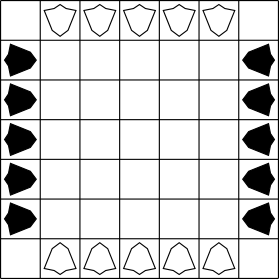
The game is played by two players. The game is played on a seven by seven board; there are specially marked squares at the border of the board, and the task of players is to connect these squares by specific pieces, called pawns. Pawns do not move like pawns, but instead are parachuted on the board. When one places a pawn on an empty square, nothing happens. However, when one places a pawn on a square where a pawn of the opponent was placed, a duel takes place. The layout of the board is shown below.
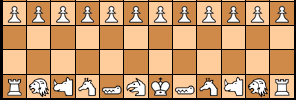
In a duel, a major piece is used. The following pieces are used: king, queen, bishop, rook (called `knight' in the game: Ritter), and Fool. (The fool moves like a rook but only one square.)
In a duel, a player chooses a major piece (but certain rules prevent players to repeatedly choose the same piece, while these pieces can be used in multiple duels). This is done secretly and simultaneously by both players. These pieces are considered to be on the square on which the duel takes place. Then, the player whose piece can move to the largest number of his pawns from the disputed square wins the duel. The pawn of the player that lost the duel must move to another piece in the influence zone of the major piece used in this turn, and if this is impossible, it is considered to be taken.
After all pawns are used, the game ends. If there is a player that has a connection between his marked squares, he wins, otherwise the player that has the largest group of connected pawns wins.
Comments
In the Pöppel-Revue article, comments on this game are given: often one should allow a defeat in a duel to have your opponent lose temporarily a major piece, and perhaps engage a duel in a square that is not so important. The set the reviewer had, had the disadvantage that one of the major pieces was distinguisable.More information
A short interview with the inventor can be found the website of Spiele-Autoren-Zunft e.V. (Game designer association): Interview with Herbert Schützdeller.A short review (in the German language) can be found at Spielphase, a German website on board games.
The game currently is no longer for sale. If a reader owns a set of this game, and can send one or more digital photo's of the set for inclusion on this page, then that would be very nice.
Written by Hans Bodlaender, based on information from Die Pöppel-Revue. Thanks to Rob Nierse for informing us on this game, and for Uwe Wiedemann for more information.
WWW page created: September 25, 1999. Last modified: Januari 21, 2012.