Lùotuoqí: Nominations
Introduction
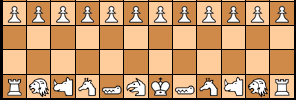
Items on this page were officially suggested (entered) for the variant-by-committee called Lùotuoqí, or Camel Chess. Voting to adopt these proposals was conducted during the first seven months of 2003, one poll at a time for one month at a time.
Pawns
The new Pawn has been adopted.
[Entrant 3] Eaglet: Moves and captures one space diagonally forward, or one space straight backward. Eaglets do not promote. (Derived from the Tori Shogi Eagle, which has rider moves in those three directions.) (Adopted February 2003.)
[Entrant 7] Novice: Moves diagonally forward to capture. When not capturing, still moves diagonally forward, but only if the square orthogonally in front of it is empty.
[Entrant 8] The basic pawns are replaced with Left Pawns (LP) and Right Pawns (RP). Both pawns moves ahead like the basic pawn including the inital dual step and en passant taking but the taking is a bit different. A left pawn takes diagonally left ahead and ortagonally to the right. The right pawn is a mirror image from the left pawn. EX: A LP on b2 can take on a3 or on c2. A RP on b2 can take on c3 or a2.
The setup is beginning with a right pawn on a2 for white and a left pawn on a7 and then alternating the LP and RP on the rows till the h file. Resulting in 4 LP and 4 RP per side.
[Entrant 10] Upgrade to a Rapid-pawn. It can move one or two squares straight forward, and capture 1 or 2 squares diagonally forward. This piece is borrowed from Henk van Haeringens Supershaak.
[Entrant 11] Checkers: Move and capture exactly as in checkers game, promote on 8th rank like Pawns. Capturing is not required, but you can capture several pieces in one move. Double move from the second line is allowed. For example, the white checker e2 can make 4 moves: d3, c4, f3, g4. En-passe capture is allowed as well. For example, if white moves Checker e2-c4 and the position c2 is empty, then the black Checker on e4 can capture the white Checker en-passe: e4-c2.
[Entrant 12] Militia: Militia pieces move as traditional pawns in all ways (double move including), but capture by making a rifle capture of any one piece adjacent to more than one militia piece belonging to the same player, and only that way. There is, of course, no en passant.
[Entrant 13] Replace the pawn with a Nickel (Ni). Nickels move and attack as standard FIDE pawns, including en passant, with the following additions:
- Nickels may move or capture diagonally forward one square, or move one square backwards without capturing.
- Nickels may capture straight forward one square, provided the enemy piece is not another Nickel.
- Nickels are allowed a double-step straight forward whenever they are on their starting rank.
- Nickels have an additional en passant-style capture called "knuckling." When two Nickels are blocking each other, and one moves or captures diagonally forward, the other Nickel may move into the vacated space and capture the first Nickel.
[Entrant 4] Piece of Eight: Represented by a single checker, it moves just like a one-stone part of a Tower of Hanoi (which is Entrant 8's for the Queen piece).
Knights
The new Knight has been adopted.
[Entrant 1] Knight: The Knight starting on the g-file must first move one square orthogonally and second one square diagonally. It may capture by replacement as in FIDE Chess, and/or, it may make a takeover capture. This is done by jumping over an opposing piece in the first square, so long as the second square is not occupied by a friendly piece.
Mirror-Knight: The Mirror-Knight, starting in place of the b-file Knight, must first move one square diagonally and second one square orthogonally. It may capture by replacement as in FIDE Chess, and/or, it may make a takeover capture. This is done by jumping over an opposing piece in the first square, so long as the second square is not occupied by a friendly piece.
[Entrant 2] Camel Chess demands a Camel, but on an 8x8 board Camels are both awkward and dangerous. So I propose that the Knight be replaced by a Lame, Marching Camel (WnL); otherwise known as a Footsore Camel. (A Footsore Camel moves one square rookwise, or moves through two empty squares rookwise, then one square diagonally outward.)
[Entrant 5] Teleporter. Moves as KNAD (one or two squares, can jump). Can't capture or be captured. Can teleport one piece (friendly or enemy but not enemy king) within its movement range to an empty square within the movement range of the owner's other teleporter.
[Entrant 7] To have a piece that preserves the colorbound character of the camel, but does not threaten too many immediate attacks on the 8x8 board, I propose the Lazy Camel (FcL). It moves and captures as a ferz, or captures only as a camel.
[Entrant 8] Knights are replaced with a Mule (M). This can move like a knight (2,1) or like a wezir (1,0). This is keeping the piece color changing with each move. (Adopted March 2003.)
[Entrant 10] Add to the Knight's normal powers the move of a Lame Camel. That is, it has the option of moving two squares orthogonally, followed by one diagonally. This is the move of the traditional fairy camel, without the leap.
[Entrant 11] Kamikaze: The Kamikaze moves and captures as knight, but can instead of moving explode itself, capturing all own and enemy pieces at 8 position around it. After explosure the Kamikaze disappears as well. The explosure is not allowed, if own King is adjecent to Kamikaze.
[Entrant 11] Terminators: Like Kamikaze, but additionally all 9 squares of the board where the explosion happened are destroyed as well (not available for further game).
[Entrant 12] Samurai: The samurai moves and captures as a knight plus a king. However, it is terribly bound by a code of honor: should the samurai ever have the opportunity to capture a honorable piece (any but a pawn) and not do so on his next move, he will commit seppuku in shame and be removed from the game. If he threatens more than one piece simultaneously, he can choose which to capture. A samurai must capture even if doing so will cause his destruction; the only exception is when doing so would cause check to his king or when his king is already under check.
Bishops
The new Bishop has been adopted.
[Entrant 2] Replace the Bishop with a Diagonal Bypasser. This piece moves diagonally, but never to an occupied square. It captures all opposing pieces on squares orthogonally adjacent to its path and not adjacent to either its starting or ending square. A Diagonal Bypasser moving from a1 to h8 would capture any opposing pieces on: b3, c4, d5, e6, f7, c2, d3, e4, f5 or g6. (Adopted May 2003.)
[Entrant 3] Roc: Combines the moves of the Alfil and the Camel...either a (1,3) leap or a (2,2) leap. Think of it as four squares with a 90 degree turn in the middle. (From Glenn Overby's Beastmaster Chess.)
[Entrant 8] Bishops are replaced by Hopping Bishops (H). This one is a combination of a dabbabba rider (0,2) with a bishop. This looks like a color bound queen.
[Entrant 10] Add to the Bishop's normal powers the move of a Lame Camel. That is, it has the option of moving two squares orthogonally, followed by one diagonally. This is the move of the traditional fairy camel, without the leap.
[Entrant 12] Dualist Monk: The Dualist Monk moves like a ferz and a wazir, that is, like a king. It can, expending one move, separate into one ferz and one wazir, one of which must be placed on the square the dualist was in, the other adjacent to it. This can be used to capture an adjacent enemy piece. Then, the dualist's owner can make two moves per turn, as long as they are one with the ferz and the other with the wazir. Should more than one dualist monk separate in a game, the resulting ferzs and wazirs are interchangeable, that is, you can make two moves, one with any such wazir, the other with any such ferz. Once separated, the pieces cannot be put together again.
[Entrant 4] Chaplain: Combination of Bishop and Pawn, except (1) no en passant capture and (2) may promote on eighth rank to any piece other than King (promotion is not obligatory). This strange notion was inspired by comments on White Elephant Chess.
[Entrant 15] Sliding Bishop: Captures as a standard bishop, when making a non-capturing move, it moves first as a standard bishop, then as a wazir. The wazir part is optional.
[Entrant 7] Crooked Picket: Moves and captures as a crooked bishop (in a series of zigzagging diagonal steps), but cannot make a one-square move. Even though it cannot move to the first square, it can be blocked there.
Rooks
The new Rook has been adopted.
[Entrant 2] Replace the Rook with the Separate Realms Rook, which moves without capturing like a Dabbabah-rider, but captures as a Rook (mDDcWW).
[Entrant 3] Proposal, identical to the first except for renaming the piece, withdrawn.
[Entrant 8] Rooks are replaced with Crowned Rooks (C). This is a rook being able to move one square diagonally like a Fers (1,1). This is the same as the promoted rook in Shogi.
[Entrant 10] Add to the Rook's normal powers the move of a Lame Camel. That is, it has the option of moving two squares orthogonally, followed by one diagonally. This is the move of the traditional fairy camel, without the leap. (Adopted July 2003.)
[Entrant 11] Roockers: Move vertically and horizontally like Rook, but capture jumping over the pieces. You can capture several pieces in one move. For example in position: White Roocker a1, Black Pawns a5, b7 and f6, the Roocker can move a1-a7-f7-f3 capturing all 3 pawns. Alternatively, it can move a1-a6-h6 or a1-a7-h7 capturing 2 pawns each time.
[Entrant 12] Dagger: A dagger moves like a wazir, plus a forward-only rook. When moving as a rook, the dagger can continue moving after it captures a piece, being able to capture a second (whereby its movement must end).
[Entrant 15] Sliding Rook: Captures as a standard rook, when making non-capturing move however, it can move as a ferz after its rookish move. Ferz part being optional.
[Entrant 4] Foundation: Combination of Rook and Knight (like Betza's Remarkable Rookies Chancellor), except it may not make Knight moves when attacked by or defended by a Mule. (Inspired by Asimov's Foundation Trilogy and Michael Nelson's Anti- Relay Chess idea.)
Queens
The new Queen has been adopted.
[Entrant 3] Fiend: Leaps exactly three spaces away from its square of origin, but not in a straight line. (It reaches up to 16 spaces in the ring three squares away which a Queen could not reach.) The Fiend does not capture. However, any enemy piece adjacent to a Fiend is frozen in place and may not move. (From Gary Gygax's Fidchell.)
[Entrant 5; amended] Killer Immobilizer. The KI moves as a Queen, but limited to three spaces. Any enemy piece adjacent to the KI (except the enemy KI) is immobilized. At the end of the KI ownwer's turn, the KI captures any enemy piece or pieces which have been adjacent to the KI for three consecutive turns (the KI might have moved from one adjacent square to another), except:
1. The KI cannot capture the enemy King or the enemy KI.
2. The KI cannot capture any piece or pieces whose removal would expose the KI's owner to check. If after four or more consective turns adjacent to the KI, the capture would not expose the KI's owner to check, the capture is made then.
The captures when legal are automatic and simultaneous. If there are two or more ways to capture when all captures are not legal, the KI's owner chooses. Example: The KI would simultaneously capture a Rook and a Knight, but removing both pieces would result in a discovered check to the KI's owner. The KI's owner must capture one or the other piece, but has free choice.
[Entrant 8] The Queen is replaced by a Tower of Hanoi (T). This pieces is a pile of 8 draught stones moving like a chess queen. It can move as one piece or divide into 2 smaller parts which can probably be splitted again. And it can merge them again. The number of draught stones determines how far it can move at maximum. If the tower have to be splitted the moving part have to contain at least as many stones as squares the moving part is moving. EX: A Tower of Hanoi which is splitting and moving 4 squares have to contain at least 4 stones in the moving part. (Adopted April 2003.)
[Entrant 10] Add to the Queen's normal powers the move of a Lame Camel. That is, it has the option of moving two squares orthogonally, followed by one diagonally. This is the move of the traditional fairy camel, without the leap.
[Entrant 11] Queckers: Combination of Roocker and checker game King. This means that it moves as a Queen, but captures by jumping over the pieces. You can capture several pieces in one move. For example in position: White Quecker d1, Black Pawns f3, g5, f7. White can move d1-g4-g6-e8 capturing all black Pawns.
[Entrant 12] Ancestral Dragon: Moves and captures like a shogi dragon-king (rook plus ferz), plus relays this movement ability to all non-royal, non-pawn pieces orthogonally adjacent to it.
[Entrant 14] The S~Pawn~ing Queen: Any time either player has less than 12 pawns they may for their turn have the Queen S~Pawn (that is, generate a Pawn) but only if there is an available space for the pawn to go. The Queen cannot S~Pawn if she is hedged in on all sides.
New Rules
The two New Rules have been adopted.
- [Entrant 2] Instead of castling, the King, if not in check, as its first move, may leap like an Alfil, Dabbabah or Knight.
- [Entrant 2] After moving, a player chooses one of their pieces, and hands it to the opposing player. The opposing player places that piece back on the board after they move, but before removing their piece. White places no piece on turn one. No pawn placements on the first or eighth rank. (Clarification: The turn order after the first move is: White moves, White places Black piece, White hands Black a White piece; Black moves, Black places White piece, Black hands White a Black piece.)
- [Entrant 3] The Cube (use any convenient off-board marker): After the player with The Cube makes a move which neither captures nor gives check, that player may give The Cube to the opponent and take a second consecutive turn. Black starts with The Cube. (Adopted January 2003.)
- [Entrant 4] A piece can be captured only if (a) at least two enemy pieces attack it (i.e. could reach in one turn the position of the piece to be captured, if that position were empty) or (b) the enemy King attacks it.
- [Entrant 6] This is based on the game's being a drop-chess. The "recapture" rule makes any dropped piece that is captured again lost from play, as opposed to once again changing ownership. (For example, black has captured one of white's pawns. Black drops the former white pawn on a subsequent turn, and white is forced to capture it three turns later. Instead of white now taking the pawn in hand to drop, that particular pawn is lost.)
- [Entrant 7] When a pawn is flanked by two adjacent pieces of the same type (not Kings), such that the three pieces form a straight line, either orthogonally or adjacently, with the pawn in the center, the pawn's owner may, as a turn, promote it to the type of piece flanking it. (Example: there is a white knight on b3, a white pawn on c4, and a black knight on d5. White may, as a turn, replace the pawn on c4 with a white knight.) (Adopted June 2003.)
- [Entrant 9] Flying Monk: A Rook, as part of the castling move, may throw a Monk from its resting place. The Monk first moves four squares orthogonally (the first two must be empty to launch). The Monk then comes to rest a knight-leap from the fourth space, captures if possible, and disappears. (Historical note: Based on the tower-jumper Eilmer of Malmesbury.)
- [Entrant 14] Rescues: Knights, Bishops, Rooks, and Queens ("pieces") may be rescued after capture. When a player moves a piece to the eighth rank, a previously captured piece (not a promoted Pawn) may be rescued. A rescued piece may be reentered on the first rank as a subsequent turn of its owner.
- [Entrant 4] Semiconductivity: A piece may travel through other *friendly* pieces, as long as its destination square is not occupied by a friendly piece that the rules do not allow the travelling piece to merge with.
- [Entrant 15] The capturing player drops the captured piece on any empty square on the board immediately after capture.
- [Entrant 7] When a player captures part of their opponent's Tower of Hanoi, they may optionally remove another part of it of equal or lesser height from anywhere on the board.