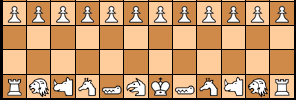
Reflex Chess
Introduction
Reflex Chess was invented in the 1880's by William Geary and B. J. Laws, and was reviewed in the May 1907 issue of Chess Amateur. It has been used primarily as a problem theme.
Rules
orthodox chess rules apply, except that the winner is the player whose king is checkmated. If a move gives mate, then the player must make such a move.
Variant: If a player indicates to his opponent that a move will lead to checkmate (in a specific, reasonably small number of moves), the opponent must make the move. However, if the move does not lead to checkmate (in the specified number of moves), then the opponent wins.
Problems
(Taken from The Encyclopedia of Chess Variants by David Pritchard)
           |
(From The Problemist iii 1930) |
       |
|
Solutions
First problem: Bb1 (threat Rg6)
Second problem: f4 (threat Re4)
Written by David Howe. Based on an email from Carlos Cetina, with information from the book on chess variants written by Gabriel Maura Vicente. Additional information and problem sets from David Pritchard's Encyclopedia of Chess Variants.
WWW page created: January 27, 1999. Last modified: February 28, 2001.