Dutch Chess
Gerben Dirksen informed me about a variant, called Dutch Chess, which he learned from someone from the U.S. The origins of this game are unknown, and, while living in the Netherlands, I had so far not heard of it.Rules
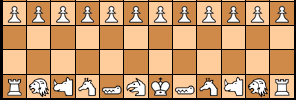
The game is played with a usual set of pieces. In the setup, the pawns are on the backrows, and the major pieces at the second rows.


Rooks and knights move as in orthodox chess. Bishops move one square in any direction (i.e., as a king, without being royal.) A pawn moves like a queen, and does not promote. King and queen move exactly two squares in any direction (horizontal, vertical, or diagonal.)
The player that has taken both the queen and the king of the opponent wins the game.
Comment
It is not as simple as it appears...Written by Hans Bodlaender, based upon information of Gerben Dirksen and David Short.
WWW page created: June 7, 1999.