Piececlopedia: Pushme-Pullyu
Historical notes
The Pushme-Pullyu was invented by Fergus Duniho in 2002 for a variation on Rococo called Supremo. (Supremo does not currently have a webpage on chessvariants.com.) Rococo also has a variant that substitutes Pushme-Pullyus for the Advancer and Withdrawer.The Pushme-Pullyu was inspired by and combines the moves of the Advancer from Rococo and the Withdrawer from Robert Abott's 1962 classic Ultima. If you're not familiar with either of these pieces it may help to read them first.
The Pushme-Pullyu is also used in Pushme-Pullyu Chess.
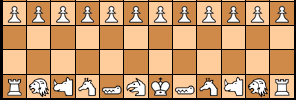
In Rococo, the Pushme-Pullyu is represented by a combination camel and knight. I have used the camel-knight for the diagrams below.
Movement
The Pushme-Pullyu's methods of movement and capture are different from each other.The Pushme-Pullyu moves as a Chess Queen - that is, the Pushme-Pullyu can move any number of squares in any direction, orthogonally or diagonally, as long as all the squares it passes over are unoccupied by other pieces. The Pushme-Pullyu can never move to a square occupied by a piece of either side.
To capture, the Pushme-Pullyu has two options:
- The Pushme-Pullyu can move directly towards an opposing piece, and end its move on the square adjacent to that piece. Just as when it moves, the Pushme-Pullyu can cross any number of unoccupied squares in any direction to make its capture. When the Pushme-Pullyu moves directly towards a piece and lands adjacent to it, capturing that piece is not optional - the piece must be removed. Note that this type of capture is identical to that of the Advancer.
- The Pushme-Pullyu must begin its move adjacent to an enemy piece, and then move directly away from that piece. Just as when it moves, the Pushme-Pullyu can cross any number of unoccupied squares in any direction to make its capture. When the Pushme-Pullyu moves directly away from a piece, capturing that piece is not optional - the piece must be removed. Note that this type of capture is identical to that of the Withdrawer.
Movement diagrams
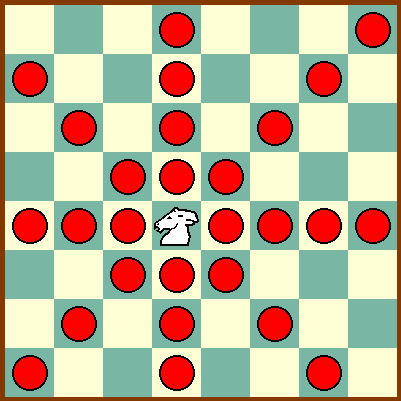
In the diagram below, the Pushme-Pullyu - represented by a camel-knight - can move to any of the squares marked with a red circle.
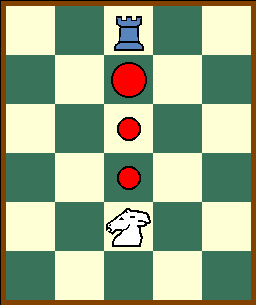
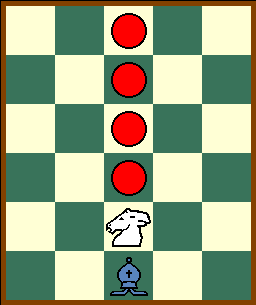
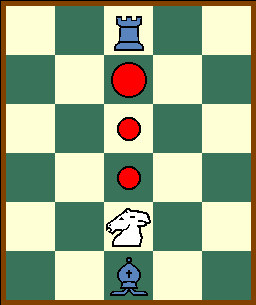
The three diagrams below demonstrate the capturing power of the Pushme-Pullyu.
In the diagram on the left, the Pushme-Pullyu can capture the Black Rook by advancing along the path marked by the circles and ending its move on the square marked by the large red circle. If the Pushme-Pullyu stops on one of the smaller circles, it will not capture Rook.
In the center diagram, the Pushme-Pullyu can capture Black Bishop by withdrawing to any of the squares marked with a large red circle. If it retreats in a different direction, it will not capture the Bishop.
The diagram on the right shows an example of how the Pushme-Pullyu can capture two pieces in one move. If it moves to the square marked with a large red circle, it will capture both the Rook by advancing and the Bishop by withdrawing. If it moves to one of the smaller circles, it will still capture the Bishop but not the Rook.
Remarks
The Pushme-Pullyu is a very powerful piece. Most of its strength lies in its advancing attack - in Rococo, the Advancer is much stronger than the Withdrawer. But the two capturing methods complement each other well. The advancing attack eliminates the Withdrawer's biggest drawback, the need to get close to pieces to threaten them, while the withdrawing power also eliminates the Advancer's biggest weakness, the inability to capture pieces on adjacent squares. The ability to capture two pieces at once is a nice bonus, although it rarely occurs in actual games.One of the best ways to defend against a Pushme-Pullyu is with your own Pushme-Pullyu. A Pushme-Pullyu can never threaten capture by advance of an opposing Pushme-Pullyu without it attacking back, unless that Pushme-Pullyu is pinned or immobilized; it is possible, however, to have Pushme-Pullyus on adjacent squares where one can capture the other but not vice versa. And because of this characteristic, the Pushme-Pullyu's other natural enemy is the Chameleon. Despite its ability to keep opposing Pushme-Pullyu's at bay, the Chameleon in Rococo and Supremo is overall a weaker piece, and thus trading a Pushme-Pullyu for one is a bad idea.
A Pushme-Pullyu and a King can easily force checkmate against a lone King.
This is an item in the Piececlopedia: an overview of different (fairy) chess pieces.
Written by Benjamin Good.
WWW page created: Sunday, August 11, 2002.