Piececlopedia: Advancer
Historical notes

The Advancer was invented by David Howe for the game Rococo, a game he created with Peter Aronson that appeared on chessvariants.com in May, 2002. The Advancer was inspired by the Withdrawer, a piece from Robert Abott's 1962 classic Ultima. As with the Withdrawer, the Advancer's method of capturing is taken from the Malgasy game of Fanorona.
The Advancer is also used in Advancer Chess and Butterfly Chess.
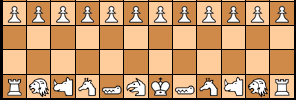
In Rococo, the Advancer is represented by a ram. Other games have followed this convention, as do the diagrams below.
Movement
The Advancer's method of movement and capture are different from each other.
The Advancer moves as a chess Queen - that is, the Advancer can move any number of squares in any direction, orthogonally or diagonally, as long as all the squares it passes over are unoccupied by other pieces. The Advancer can never move to a square occupied by a piece of either side.
To capture, the Advancer must move directly towards an opposing piece, and end its move on the square adjacent to that piece. Again, the Advancer can cross any number of unoccupied squares in any direction to make its capture. Note that if the Advancer moves directly towards an enemy piece and lands adjacent to it, capturing that piece is not optional.
Movement Diagrams
In the diagram on the left, the Advancer can move to any of the squares marked with a red circle.
In the diagram on the right, the White Advancer can capture the Black Queen by moving along the path of red circles and ending its move on the large red circle on d5. If it stops on one of the smaller red circles on e6 or f7, the Advancer will not capture the Queen. Note that if the Advancer does capture the Queen, it will not capture either Black Knight because it did not move directly towards them.
The Black Advancer can capture the White Pawn by following the path of circles to the large red circle on f2. In doing so, it will not, however, capture the White Bishop — the Advancer only captures the first piece it reaches. The Advancer can not capture the White Rook, since it is already adjacent to it, and therefore can not move towards it.
You can also see an animated demonstration of the Rococo pieces, including the Advancer, by clicking here.
Remarks
The Advancer is a powerful piece, almost as strong as a chess Queen. It can attack pieces from far away, and since it does not capture by displacement, threatened pieces can not be protected by direct defense. Each piece potentially has eight locations where it is vulnerable to Advancer attack. The Advancer's biggest weakness is that it can not capture pieces on adjacent squares; if a piece is threatened by an Advancer, often the best defense is to move next to it.
Note that it is not possible for an Advancer to attack an another Advancer without being attacked back, unless that Advancer is pinned or immobilized.
In the endgame of an Advancer and a King against a lone King, the Advancer and King can force checkmate. The process is similar, but not identical, to that used to checkmate a lone King with a King and a rook — the Advancer boxes in the opposing King, driving it into the corner. The trick in this case is to keep your own King between the opposing King and your Advancer, since otherwise the King can move adjacent to your Advancer and slip out of the net. Once you've driven the King into a corner of the board, you must gain opposition with your King, meaning your King and his King must be on the same rank or file. In order to force this, you may need to make a move with your Advancer to both gain tempo and cut off the enemy King. This is illustrated in the diagram below.
White has driven Black's King to the lower left corner. Black now has three available moves. If he plays 1...Ka3, White wins with 2.Aa7#. If he plays 1...Ka1, he is defeated by 2.Kb3 Kb1 3.Ag1#. His only remaining option then is 1...Kb1.
In order to gain opposition now, White must make a waiting move. If he plays 2.Kb3, Black can respond 2...Kc1; if White moves his King back to c3, Black will play Kb1 and White has gained nothing. Instead, White must play a move with his Advancer that both keeps the Black King from returning to a2, and still leaves him in a position to deliver checkmate. Both 2.Ac4 and 2.Ad5 work. Then 2...Kc1 is met by 3.Af1# or Ah1#, and 2...Ka1 is followed by 3.Kb3 Kb1 4.Af1# or Ah1#.
This is an item in the Piececlopedia: an overview of different (fairy) chess pieces.
Written by Benjamin Good
Updated by Greg Strong
WWW page created: 2002-08-11
WWW page updated: 2020-12-16