Train Wreck Chess
Peter Aronson
Introduction
Train Wreck Chess is a sort of cross between Ron Drinning's game of Double Moves and Hans Bodlaender's game of Draughts Chess (itself a variant of Checkers Chess), where both players move pieces belonging to both sides, and movement is usually only forward, and victory is often by stalemate.Board and Setup
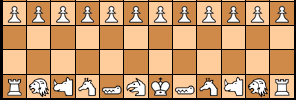
The usual Orthochess board, pieces and array are used for Train Wreck Chess.Rules
The rules of Train Wreck Chess are identical to those of FIDE Chess, except where noted otherwise below:- Sequence of play is as follows: each turn, first move any one of your pieces, then move any one of your opponent's pieces except for their King. (Castling with a King counts as a King move.) When you move an opponent's piece, "forward" is defined as away from their starting row. Your pieces only may capture opposing pieces, regardless of who is moving them, and your opponent's pieces may only capture your pieces, again, regardless of who is moving them.
- Victory is by capturing the opposing King (not checkmate) or by when your opponent has no legal move (stalemate).
- Pieces may only move forward, except when castling or capturing. Thus, when not capturing or castling, a King may step in any of the three forward directions, a Queen may slide in any of the three forward directions, a Rook may slide forward (but not sideways), a Bishop may slide in either of the two forward diagonal directions, a Knight may perform any of the four forward leaps, and a Pawn's movement is unaffected.
- Queens may castle with Rooks in the same manner as do Kings, except unlike Kings, they may castle when in, through, or into attacked squares.
- There is no en-passant capture.
- When a Pawn moves to the opposite side of the board, the moving, not the owning player, decides what type of piece it promotes to.
If it is a player's turn to move an opposing piece, and their opponent has no pieces remaining that can move other than their King, that is a loss by stalemate for the moving player.
Variants
While this variant is probably not a good candidate for Chess with Different Armies -- the changes in movement not being value preserving -- it should work as well as is does with the Orthochess array with any variant that merely varies the piece mix, such as Berolina Chess or Almost ChessIf you want to give a player more control over how their pieces are being moved, you could play Three-Move Trainwreck Chess where, except for White's first move (which is like regular Trainwreck Chess), you make two moves with your own pieces, then one with your opponents'. (This version could also be called Two Steps Forward and One Step Back.)
Notes and Comments
I was playing around with Ron Drinning's game, Double Moves, and it seemed to me that even with a Ko rule of some sort, it was hard to get anything done since your opponent was disarranging your pieces as fast as you were arranging them. So I started adding features, like forward-only movement to force something to happen. Even so, there were a lot of stalemates, so I decided to use that, making it one of the ways to win. The Queen-castling was added to give the poor Rooks a tiny bit more mobility.The reason this game is named "Train Wreck Chess" is that when I first designed it, before playtesting, I rather thought with the forward-only movement, pieces would sort of crash together in the middle of the board, making something of a train wreck. Well, it doesn't play like that, but I decided I liked the name anyway.
Thanks to John Lawson and Tony Quintanilla for playtesting.
Strategy and Tactics
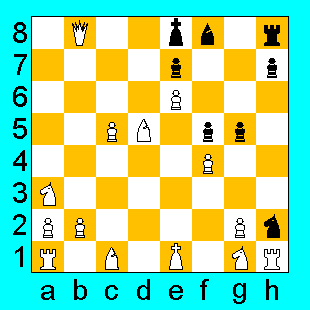
The idea was for this to be another dynamic tension game, like Anti-King Chess, where the player should be torn between capturing opposing pieces to clear the way at their King, vs leaving them there as a guard against stalemate, while simultaneously wanting to hold on to one's own pieces to attack the opposing King, and wanting to get rid of them to stalemate your opponent.I have no idea, really, if it works that way in practice, despite having played several games against human opponents as well as some against Zillions. A typical winning position for White from Zillions vs Zillions is below, since Black is stalemated without a White piece to move (Black to move a White piece):
However, I don't believe Zillions plays this game very well, since it concentrates on obtaining what I suspect is an irrelevant or even harmful material advantage. Mind you, you can get carried away trying to get rid of your material in the search for stalemate; below is the final position of a game I lost to John Lawson where I gave away too much too soon (Black to move a Black piece):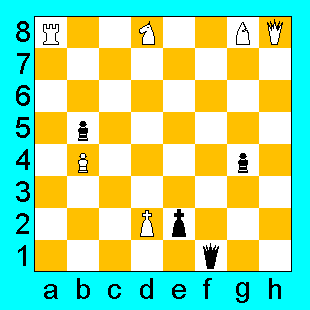
Computer Play
I've written an implementation of Train Wreck Chess for Zillions of Games.The ZRF also includes Berolina Train Wreck Chess, Almost Train Wreck Chess and Three-Move Train Wreck Chess.
Written by Peter Aronson.
WWW page created: December 28th, 2004.