Lichen Chess
So I got to thinking about what sort of game you could make if the pieces were modular, and each piece could contain fragments belonging to both players. This is based on a game played by young druids with magical lichen that could make stones encrusted with it float through the air. But magical lichen is so hard to find these days. The mechanic of a having a limited number of pieces which are placed on the board from a store and which must be returned to that store or cause the player whose store is exhausted to lose is borrowed from Gipf. The bit about a player losing when e loses a specific piece is borrowed from chess.
Initial Setup:
Eight stones are placed on a rectangular board of 5 by 3 squares as in the diagram below. Each stone has 8 spaces on which tokens can be placed. Each player begins with 3 tokens in play on stones as shown, and 20 additional tokens in hand. The central stone on each side is the kingstone of the player who starts with a token on that stone.
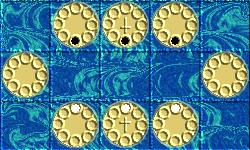
setup of board at the beginning of the game
Control of Stones:
A stone is controlled by the player with the largest number of tokens on that stone. When the number of tokens each player has on the stone are equal, the stone is controlled by neither player. If a player gains control of eir opponents kingstone, e wins the game.
Order of Play:
Players alternate turns. Each turn consists of two phases, placing a token and moving a stone.A token may be placed from one's hand into any empty space on any stone, regardless of who controls that stone. It is not possible to pass, and avoid placing a token. If one is out of tokens in hand when it is time to place the token, one loses immediately. After placing the token, one may move any stone that one controls to an empty square in the direction of one of that players tokens on that stone. Alternatively, one may colonize a stone that lies in the direction of a token on a stone one controls. This involves placing a token from one's hand to the same position on the colonized stone as the token on the colonizing stone that "points to" the colonized stone. If there is already a token of the opposite color in that position, it is captured, and removed from the game. If there is already a token of the same color in that position, the colonization cannot be made.
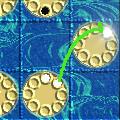
The stone on the lower left colonizes the stone on the upper right.
At the begining of a player's turn, if that player controls a stone with all 8 positions filled, all of that player's tokens on that stone are returned to eir hand, and all of eir opponent's tokens on that stone are removed from the game.
Some thoughts:
The gipf-like rules were added on because I was worried that without them the game could become very boring after the stones were filled up. However they may complicate things unnecessarily, and there may be a better way to keep the token composition of the stones dynamic.My original version of the game had only the 9 central squares. I added the extra columns because I thought it would be interesting to have stones that begin neutral, (and also because 3 x 3 is a little small for a chess variant, even where the state of the individual pieces is very rich in information as it is here.) However I am worried that the opening (for white), Place A2(Northeast) A2-colonize-B1 is too strong this way.
I am working on a related variant, which is larger and has "stones" that belong to only one player in it, but which has more than one kind of token, and allows drops of tokens from captured pieces onto other pieces.
This is a game, on Alexandre Muñiz's Web Thing. This is only a game. If it had been reality it would not have come with instructions. Send comments to (email removed contact us for address) t.net.
Written by: Alexandre Muñiz.
WWW page created: December 8, 1999.