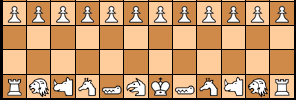
Unicorn Chess
Description and History
This entry into the 100 Square Contest is played on a 10x10 board. Each side has 10 Pawns and 12 pieces. New pieces are the Chancellor (moves like a Rook or a Knight) and the Unicorn (moves like a Bishop or a Nightrider). I first tried Chancellors on the corner squares in an earlier variant (on a 10x8 board).
I got the idea of giving each side 22 men from Great Chess, but decided to place the Knights on the 2nd and 9th ranks.
The Nightrider makes repeated Knight moves along a "straight line" and can only be blocked by a man on one of the squares the Nightrider touches down on. There is no legal checkmate on a board with only a King, a Nightrider, and the opponent's King. I avoided this frustrating problem by combining a Nightrider with a Bishop to make a new piece, the Unicorn. Even the name is (almost) new - the earliest use I recall is in a 3D variant. On 100 squares, the Unicorn is about the same strength as the Queen. However, Knights and Chancellors are definitely weaker than Bishops and Queens on 100 squares.
White Pawns on the second rank may advance 1 or 2 squares. The same rule applies to White Pawns on e3 and f3. NOTE: if White plays d2xe3, the new Pawn on e3 still has the right to advance either one or two squares (to e4 or e5), in spite of the fact it has already made its first move. Similar rules apply to Black Pawns on the ninth rank, also e8 and f8. En Passant rules hold for this variant. A Pawn promotes to a Chancellor, Queen, or Unicorn of the same colour upon reaching the player's tenth rank. These are the only choices allowed for promotion.
Castle "as usual" with the Kings and Rooks. For the player with the White pieces, the notation O-O means the King moves from f1 to h1 and the Rook moves from i1 to g1, while O-O-O means the King moves from f1 tod1 and rhe Rook moves from b1 to e1. Note that every Pawn has two defenders in the initial position, which may lead to safer openings in this variant. But some openings are not safe, consider this Fool's Mate: 1. b3 e7?? 2. Ub2 mate.
      a   b   c   d   e   f   g   h   i   j
    +---+---+---+---+---+---+---+---+---+---+
  0 |*C*|*R*|*U*|*B*|*Q*|*K*|*B*|*U*|*R*|*C*| 0
    +---+---+---+---+---+---+---+---+---+---+
  9 |*P*|*P*|*P*|*P*|*N*|*N*|*P*|*P*|*P*|*P*| 9
    +---+---+---+---+---+---+---+---+---+---+
  8 |   |:::|   |:::|*P*|*P*|   |:::|   |:::| 8
    +---+---+---+---+---+---+---+---+---+---+
  7 |:::|   |:::|   |:::|   |:::|   |:::|   | 7
    +---+---+---+---+---+---+---+---+---+---+
  6 |   |:::|   |:::|   |:::|   |:::|   |:::| 6
    +---+---+---+---+---+---+---+---+---+---+
  5 |:::|   |:::|   |:::|   |:::|   |:::|   | 5
    +---+---+---+---+---+---+---+---+---+---+
  4 |   |:::|   |:::|   |:::|   |:::|   |:::| 4
    +---+---+---+---+---+---+---+---+---+---+
  3 |:::|   |:::|   |:P:| P |:::|   |:::|   | 3
    +---+---+---+---+---+---+---+---+---+---+
  2 | P |:P:| P |:P:| N |:N:| P |:P:| P |:P:| 2
    +---+---+---+---+---+---+---+---+---+---+
  1 |:C:| R |:U:| B |:Q:| K |:B:| U |:R:| C | 1
    +---+---+---+---+---+---+---+---+---+---+
      a   b   c   d   e   f   g   h   i   j
Alternate Board
There is no international standard for 10x10 boards, so I am providing an alternate board below, with dark squares at the players' right hands and a slightly different numbering system. I find diagrams like these useful for playing email chess.
      a   b   c   d   e   f   g   h   i   j
    +---+---+---+---+---+---+---+---+---+---+
  9 |*C*|*R*|*U*|*B*|*Q*|*K*|*B*|*U*|*R*|*C*| 9
    +---+---+---+---+---+---+---+---+---+---+
  8 |*P*|*P*|*P*|*P*|*N*|*N*|*P*|*P*|*P*|*P*| 8
    +---+---+---+---+---+---+---+---+---+---+
  7 |:::|   |:::|   |*P*|*P*|:::|   |:::|   | 7
    +---+---+---+---+---+---+---+---+---+---+
  6 |   |:::|   |:::|   |:::|   |:::|   |:::| 6
    +---+---+---+---+---+---+---+---+---+---+
  5 |:::|   |:::|   |:::|   |:::|   |:::|   | 5
    +---+---+---+---+---+---+---+---+---+---+
  4 |   |:::|   |:::|   |:::|   |:::|   |:::| 4
    +---+---+---+---+---+---+---+---+---+---+
  3 |:::|   |:::|   |:::|   |:::|   |:::|   | 3
    +---+---+---+---+---+---+---+---+---+---+
  2 |   |:::|   |:::| P |:P:|   |:::|   |:::| 2
    +---+---+---+---+---+---+---+---+---+---+
  1 |:P:| P |:P:| P |:N:| N |:P:| P |:P:| P | 1
    +---+---+---+---+---+---+---+---+---+---+
  0 | C |:R:| U |:B:| Q |:K:| B |:U:| R |:C:| 0
    +---+---+---+---+---+---+---+---+---+---+
      a   b   c   d   e   f   g   h   i   j
Playing Tips
Tip1: Avoid reckless Pawn advances while your opponent still has both Unicorns.
Tip2: Avoid moving the King to a corner square while your opponent still has many powerful pieces, as your defenses could be overwhelmed by a sudden attack.
  __       copyright (c) 1999, 2000       __
 / o\--                                --/o \
 \ \/        by David Paulowich          \/ /
 /  \                                    /  \
[====]         (email removed contact us for address) .net            [====]
Download
A ZRF for Unicorn Chess can be downloaded here:
Written by David Paulowich. Slight addition by Fergus Duniho.
WWW page created: June 30, 2000. Last Updated October 23, 2000.