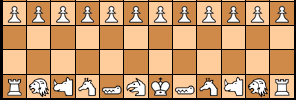
Royal Chess
John Gollon, author of Chess Variations: Ancient, Regional, and Modern collected materials for a second book on chess variants, that was unfortunately never published. Part of his draft for his second book was sent to Eric Greenwood in 1976; Eric wrote in 1997 to me about what he received from Gollon. This variant was sent to Gollon by R. Douglas Wells from College Park, Maryland. This game clearly was inspired by Shatranj or one of its larger variants.
Rules
The game is played by two players on a board with eight rows and ten columns. Each player has a king, two rooks, two bishops, two knights, two elephants, one firzan, and ten pawns.
The opening setup is as follows.
 White:
King f1; Firzan e1; Rook a1, j1; Knight b1, i1; Bishop c1, h1; Elephant
d1, g1; Pawn a2, b2, c2, d2, e2, f2, g2, h2, i2, j2.
Black:
King f8; Firzan e8; Rook a8, j8; Knight b8, i8; Bishop c8, h8; Elephant
d8, g8; Pawn a7, b7, c7, d7, e7, f7, g7, h7, i7, j7.
Movement of pieces and other rules
The firzan moves one square diagonally. Elephants move one or two squares diagonally - they cannot jump. All other pieces move as in usual chess, except that pawns always promote to firzan when they reach the last row.
For castling there are the following three possibilities:
- (Castling on the kings side:) In one move, the king moves to h1 (h8) and the rook moves to g1 (g8). (Blacks castling is given between brackets.)
- (Castling on the firzans side, 1st possibility:) In some move, the king is moved to e1 (e8). Then, in a later (not necessarily the next) move, the king is moved to c1 (c8), and simulatenously, the rook is moved to d1 (d8).
- (Castling on the firzans side, 2nd possibility:) In some move, the rook is moved to b1 (b8). Then, in a later (not necessarily the next) move, the king is moved to d1 (d8), and simulatenously, the rook is moved to e1 (e8).
A player that is stalemated loses the game. All other rules are as in orthodox chess.
Written by Hans Bodlaender, based on materials from John Gollon, sent by Gollon to Eric Greenwood in 1976, and send by Eric Greenwood to me in 1997.
WWW page created: October 15, 1997.