Zelda Chess
By Adam Norberg
Introduction
Zelda Chess was inspired by the Zelda fantasy video games by Nintendo where a character attacks an adjacent opponent with their sword. In Zelda Chess, all captures are made by adjacent pieces -- there is no capture by replacement. Also, three times a game a player may make a special attack that captures all pieces of either side adjacent to a selected piece.
Initial Board and Setup
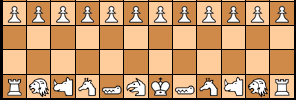
Zelda Chess uses the standard orthodox chess board and starting array.
Rules
The game is conducted by rules of International Chess with the following changes:
- All capture is by adjacency. Two pieces are considered adjacent if their squares share a side or a corner. You may move your piece, and then capture a single opposing piece adjacent to your landing square, or, if you start your turn with a piece or pieces adjacent to an opposing piece or pieces, you may capture one of those adjacent pieces without otherwise moving, and that counts as your move for the turn.
- Capture is optional, but if you do not make a capture without moving, you must move a piece or make a special attack (see below). You may never move to a square occupied by another piece.
- Pawns may only move forward -- they have no diagonal move. They capture by adjacency like all other pieces. They may still move two squares on their first move, but there is no en-passant capture in the normal sense (nor any need for it).
- Three times total during a game, each player can have one of their pieces execute a special attack. The piece does not move, but all adjacent pieces of either side are removed from play. This move may be used even if the piece in question does not have any other pieces adjacent to it. You may not make a special attack with a piece next to your King. Paper or some sort of counter is recommended to keep track of your special attacks.
The game is won by checkmating your opponent's King.
Examples of Capture
The following diagram shows some capture possibilities:
       +---+---+---+---+---+---+---+---+
     8 |   |...|   |...|   |...|   |...|
       +---+---+---+---+---+---+---+---+
     7 |...|   |.k.|   |...|   |...|   |
       +---+---+---+---+---+---+---+---+
     6 |   |...|   |...|   |...|   |.N.|
       +---+---+---+---+---+---+---+---+
     5 |...|   |...|   |.R.|   |[*]|   |
       +---+---+---+---+---+---+---+---+
     4 |   |...|   |.P.|   |...| p |[*]|
       +---+---+---+---+---+---+---+---+
     3 |...|   |...|   |...| n |...|   |
       +---+---+---+---+---+---+---+---+
     2 |   |...|   |[*]|   |.P.| P |.P.|
       +---+---+---+---+---+---+---+---+
     1 |...| K |.B.|   |[*]|   |[*]|   |
       +---+---+---+---+---+---+---+---+
         a   b   c   d   e   f   g   h
The lower-cased, underlined letters indicate black pieces, the
uppercase letters indicate white pieces, the characters "[*]"
indicate a square that the black Knight on f3 could move to.
The black Knight has the following possible moves:
- The black Knight could stay on f3, and capture a white Pawn on f2 or g2.
- The black Knight could jump to g5, where it could capture the white Knight on h6.
- If the black Knight jumped to h4, the black player could make no captures this turn.
- The black Knight can not jump to d4, e5 or h2 as they are occupied.
- If the black Knight jumped to d2, it could capture the white Bishop on c1.
- If the black Knight jumped to e1, it could capture the white Pawn on f2.
- If the black Knight jumped to g1, it could capture a white Pawn on f2, g2 or h2.
- If the black player hasn't used all three of their special attacks, the Knight may stay on f3, and make a special attack that captures the white Pawns on f2 and g2 and the black Pawn on g4.
Zillions of Games
There is an implementation of Zelda Chess for Zillions of games. You can download it here:
Written by Adam Norberg. HTML Conversion by Peter Aronson.
WWW page created: August 22st, 2001.