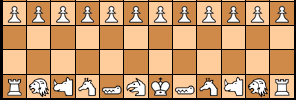
MegaMan Chess
In MegaMan Chess, pieces dont move when they capture; they fire projectile weapons at each other. So pieces do not move when they capture; they remain in the place they started and the piece they capture is removed.. However, a piece cannot be captured by just any other piece. There are four basic types of pieces: Orthogonal, Diagonal, Jumping, and Short, denoted by O, D, S, and J. Pieces have a basic type of whatever type of movement they have, so Rooks are O, Bishops are D, Knights are J, Kings and Pawns are S, and Queens are both O and D. Now a piece cant just be captured by any other piece - just as in Megaman games, each type has its weakness. O pieces are weak to D, D to J, J to S, and S in turn to O. Each type is also strong at defending against others of its own type. What does this mean? Well, normally a piece can capture one other piece on any given turn. But if an attacking piece has multiple attacks possible against pieces of the type that is weak to its own type, it can capture all of them at once! And if a defending piece has the same type as an attacking piece, two attackers are needed to take it out, since the defender is being attacked with his own weapon which he is strong against. (Its hard to fight fire with fire.)But now comes the fun part: When a piece captures another piece, the capturing piece, just like MegaMan, gets to take on the weapons of the captured piece in addition to its own. It takes on only the attack type, however, not the weakness, strength, or the move type. In other words, if a pawn captures a rook, the pawn can now attack as if it were a type O piece as well as a type S piece. But the pawn cannot move as a rook, nor is it weak to D pieces attacks or strong against O pieces attacks. If a piece captures another piece that has taken on abilities from yet another capture, the capturing piece takes on all of those abilities.
Check and checkmate rules still apply, check being defined as a threat to capture the king, with either one piece in the case of normal or multiple attacks, or two pieces in the case of kings and pawns (since they are of the same type). Note that in this game it is possible for the two kings to meet, because neither can capture the other without the aid of a pawn.
Also, when a pawn promotes, it changes its move/capture type to whatever it promotes to and gains that pieces weapons in addition to its own. And en passant and castling are in effect, though just like with any other capture, the capturing pawn in en passant does not move.
Written by Edward Kolis.
WWW page created: October 26, 2002.