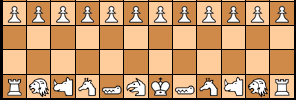
Sanctuary Chess
By Paul DeWitte
Introduction
Most chess variants require a player to "subjugate" an opponent by checkmating his king. In variants such as Grand Crossing Chess, Mexican King Chess, Occupation Chess, and Outpost Chess, a player sometimes wins by maneuvering his royal piece to a "safe" square or "safe" area. In Sanctuary Chess, a player wins by moving any two non-royal pieces to the opposite end rank.
Board
The game uses the standard 8X8, 64-cell chess board.
Setup

There is neither a king nor a queen. As a result, no piece in the game is royal. Instead of a queen, each side has an archbishop, and instead of a king, each side has a Swiss guard.
Pieces
The game uses the same rules as regular chess, except for the differences
noted in the description that follows.
 According to the Piececlopedia, the archbishop goes by a variety of names,
including the "cardinal", "minister", "vizir", and
Fergus Duniho's elegant monicker, the "paladin". (I have chosen
the names "archbishop" and "Swiss guard" because I feel they
fit with the medieval sanctuary imagery that I have tried to evoke in this
game.) The archbishop is actually a bishop-knight compound.
According to the Piececlopedia, the archbishop goes by a variety of names,
including the "cardinal", "minister", "vizir", and
Fergus Duniho's elegant monicker, the "paladin". (I have chosen
the names "archbishop" and "Swiss guard" because I feel they
fit with the medieval sanctuary imagery that I have tried to evoke in this
game.) The archbishop is actually a bishop-knight compound.
 The
Swiss guard, a piece that I have been unable to find in the Piececlopedia, jumps
one or two spaces orthogonally, or one or two spaces diagonally. It
captures in the same manner.
The
Swiss guard, a piece that I have been unable to find in the Piececlopedia, jumps
one or two spaces orthogonally, or one or two spaces diagonally. It
captures in the same manner.
Rules
A player wins by getting any two pieces to the end of the board (his
opponent's major-piece rank) and ensuring that his opponent cannot capture
either in his next move.
A pawn does not promotes at this rank, instead it becomes an ensconced
"refugee". Such a refugee cannot move, but it also cannot be
captured. Other than for this rule, pawns behave exactly as they do
in regular chess. En passant captures are legal. There is no
castling.
Equipment
Standard chess equipment can be used. Queens can represent archbishops; kings can represent Swiss guards.
Credits