Chaos Chess
Rules
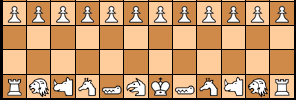
Played on 8 x 8 board with standard pieces, but a radical setup (only for those who are feeling a little crazy).Setup
Use a die-roller or random number generator to generate 100 numbers from 01-100 (11-88 if possible). Discard all numbers less than 11, greater than 88, or that end in 9 or 0. The remaining numbers represent algebraic locations on the board: 11 = a1, 36 = c6, 77 = g7, etc. (Or take 64 slips of paper, each with the notation of one square on the board, place in a container, shake, and draw one slip at a time, then discard).Read down the random number list, placing the pieces on algebraic locations in the order: white king, black king, white queen, black queen, white rooks, black rooks, white bishops, black bishops, white knights, black knights, white pawns, black pawns.
Exceptions
- Kings may not be placed next to each other (choose the next random number or slip).
- Either king may be put in check or mate by the placement of opposing pieces; this is allowed to remain (see PLAY #2).
- Bishops can be placed on the same color squares.
- White pawns may be placed on ranks 1-6 (only). Black pawns may be placed on ranks 3-8 (only).
Play
Play is, well, chaotic from the beginning. Some games will be very short (ie, your king is surrounded by opposing pieces) and most will be bloody from the start.Rule Changes
- Pawns on ranks 1-2 (white) or 7-8 (black) may move 1 OR 2 spaces on their first move. En passant capture is allowed.
- The power of all pieces to check or mate is suspended on the first turn, and returns on the second turn. Thus, even if a king is in mate on the first turn, he may move or capture to get out of it.
This variant has not been completely tested. I would appreciate any comments from those who tried it, and any suggestions for necessary rules changes. Thank you. Reactions to Allen F. Jett, (email removed contact us for address) mail.com.
Comment
To make the game fair, a method like used in Trancendental Chess seems a good idea: two games with the same setup are played in a row or concurrently, and each player has once white and once black in the two games.Written by Allen Jett, with additional comment and small changes made by Hans Bodlaender.
WWW page created: August 21, 1997. Last modified: November 3, 1997.