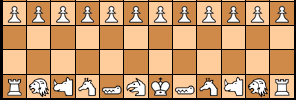
Chessapawn
by Robert Price
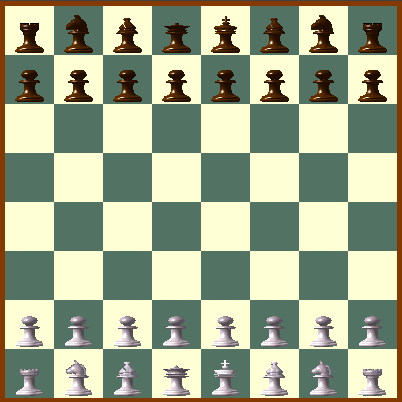
This game is an adaptation of Martin Gardner's Hexapawn to a full chess board. It was also influenced by Johannes Tranelis' Alapo.
Rules
Each piece is a Pawn in addition to its ordinary piece type. However, no piece is allowed to move backwards, and pieces can only move sideways when capturing.
In the table below, blue circles mark spaces that can be moved to without capture; yellow marks those that can be captured; and green marks spaces that can be moved to with or without capture.
Pawn | The Pawn moves as in Chess. On its first move it may move two forward without capturing if unobstructed. Immediately after such a move, it is vulnerable to en passant capture by any piece. | 
|
KnightPawn | The KnightPawn can make any of the four forward knight moves, or move as a Pawn without the double-step. | 
|
BishopPawn | The BishopPawn moves diagonally forward any number of spaces, or moves one space forward without capturing. | 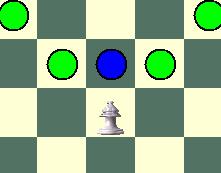
|
RookPawn | The RookPawn slides any number of spaces forward, or captures one diagonally forward. It may also slide any number of spaces sideways to capture. | 
|
QueenPawn | The QueenPawn moves as a BishopPawn or RookPawn. | 
|
KingPawn | The KingPawn steps one space straight or diagonally forward, or captures an adjacent piece to the side. It does not have special significance like the King in Chess; nothing special happens when it is captured. | 
|
The object of the game is to stalemate your opponent, or to promote one of your pieces by moving it to the far rank such that it cannot be immediately captured.
Since each move is a move forward or a capture, no move can ever be "undone". This means there is no draw by repetition. In fact, there is no draw at all.
Strategy
Knights seem to be good pieces to develop early on. They can cross the board more quickly than pawns; and in their starting position, they inhibit defense of the home row.Don't wait too long to connect your rooks. It usually takes three carefully positioned pieces to overcome a pair of connected rooks. Of course, rooks have the weakness of being unable to dodge an incoming attack by shifting to the side; so they will eventually be overcome. You'll have to mount your own attack before your defense fails. Attacking is easier here than in chess, because instead of a single piece your target is the entire back rank.
Sample Game
Read the author's commentary on a game played by a computer, or try your hand at a small collection of Chessapawn puzzles.
Zillions
Play this game with Zillions!
Written by Robert Price.
WWW page created: November 3rd, 2001.