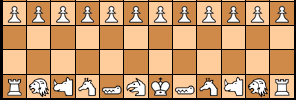
Anti-King Chess
By Peter Aronson
Introduction
Anti-King Chess is a variant that adds an Anti-King to the standard set of pieces used in FIDE Chess. An Anti-King is a King that is in check only when not attacked by opposing pieces. The goal of Anti-King Chess is to checkmate either your opponent's King or Anti-King.
Anti-King Chess I
Board and Setup
Each player starts with the usual set of pieces for FIDE Chess, and an Anti-King (represented by the upside-down Kings in the graphic below).
                                        
|
  +---+---+---+---+---+---+---+---+
8 |   |:::| p |:r:| b |:k:| q |:A:|
  +---+---+---+---+---+---+---+---+
7 |:::|   |:p:|   |:n:| n |:b:| r |
  +---+---+---+---+---+---+---+---+
6 |   |:::| p |:p:| p |:p:| p |:p:|
  +---+---+---+---+---+---+---+---+
5 |:::|   |:::|   |:::|   |:::|   |
  +---+---+---+---+---+---+---+---+
4 |   |:::|   |:::|   |:::|   |:::|
  +---+---+---+---+---+---+---+---+
3 |:P:| P |:P:| P |:P:| P |:::|   |
  +---+---+---+---+---+---+---+---+
2 | R |:B:| N |:N:|   |:P:|   |:::|
  +---+---+---+---+---+---+---+---+
1 |:a:| Q |:K:| B |:R:| P |:::|   |
  +---+---+---+---+---+---+---+---+
a b c d e f g h |
|
|
General Rules
The rules of Anti-King Chess I are identical to those of FIDE Chess, except for the addition of an Anti-King for each side, the movement of the Pawns, the King's special move, and the initial setup.
The Anti-King is a King that is in check whenever it is not attacked by opposing pieces. If a player ends their turn with their Anti-King not attacked, they are checkmated and lose. Additionally, the Anti-Kings in this game may not capture opposing pieces, only friendly ones. Since Anti-Kings are a form of King, they may not be captured, only mated. Anti-Kings do not offer check to friendly Kings. Kings do not attack Anti-Kings, so an Anti-King next to a hostile King but not attacked by any other piece is not attacked and so in check.
Pawns in Anti-King Chess I are Berolina Pawns, which move diagonally forward one square without capturing, or move one square straight forward to capture. They have no double move or en passant capture in this game. Pawns promote as usual to the owning player's choice of Knight, Bishop, Rook or Queen.
If a King or Anti-King has not yet moved, it may make as its first move a Knight's leap to an empty square. This is what this game provides instead of castling. Unlike castling, the King's leap may be used to escape check.
Anti-King Chess is won either by checkmating your opponent's King (by attacking it so that it may not escape) or by checkmating your opponent's Anti-King (by stranding where it can not reach an attacked square).
Notes and Comments
This game was inspired by reading about Anti-Kings and Anti-Chess on George Jelliss' A Guide to Variant Chess site. But it seemed to me that Anti-Chess as described there would be a kind of dullish game, since each side would avoid capturing their opponent's pieces, since reducing their number only helped their opponent to achieve mate. I considered making captures obligatory, but that produces a very unchess-like game. Then the idea of having both a regular King and an Anti-King came to me. Dynamic tension! A player will be torn between capturing opposing pieces in order to make way for a mating attack on the opposing King, and making sure their Anti-King isn't left without attackers. The array was inspired by the arrays used in V.R. Parton's games of Neutral King Chess and Rettah, and by Brian Wong's game Separate.
Berolina Pawns make promotion more likely (which may not always be good for a player) and the odd-set up less of an issue. Additionally, Berolina Pawns were sometimes once called Anti-Pawns, which fits in nicely with the theme.
The rule that an Anti-King does not give check to a friendly King is slightly arbitary, and could be with dispensed with. It would probably not make a great difference. The King's initial Knight's leap and the rule that Kings do not attack Anti-King are the sort of fiddly little rules that get added because they improve play. Neither is strictly necessary, although without the second the Anti-King tends to attach itself to the King and stick on it like a leech.
I haven't been able yet to determine who invented the Anti-King. Jelliss' site gives an Anti-King problem by J.E.H. Creed, but there's no statement about who invented the piece.
Thanks to Ben Good and Tony Quintanilla for feedback and playtesting.
Equipment
Anti-King Chess can be easily played with a normal Western Chess set -- all you need are two extra pieces for the Anti-Kings. Perhaps Queens from a smaller Chess set or Bishops from a larger set could be used.
Anti-King Chess II
Board and Setup
Each player starts with the usual set of pieces for FIDE Chess, and an Anti-King (represented by the upside-down Kings in the graphic below).
  
|
   +---+---+---+---+---+---+---+---+
8  | r |:n:| b |:q:| k |:b:| n |:r:|
   +---+---+---+---+---+---+---+---+
7  |:p:| p |:p:| p |:p:| p |:p:| p |
   +---+---+---+---+---+---+---+---+
6  |   |:::|   |:A:|   |:::|   |:::|
   +---+---+---+---+---+---+---+---+
5  |:::|   |:::|   |:::|   |:::|   |
   +---+---+---+---+---+---+---+---+
4  |   |:::|   |:::|   |:::|   |:::|
   +---+---+---+---+---+---+---+---+
3  |:::|   |:::| a |:::|   |:::|   |
   +---+---+---+---+---+---+---+---+
2  | P |:P:| P |:P:| P |:P:| P |:P:|
   +---+---+---+---+---+---+---+---+
1  |:R:| N |:B:| Q |:K:| B |:N:| R |
   +---+---+---+---+---+---+---+---+
a b c d e f g h |
|
|
General Rules
The rules of Anti-King Chess II are identical to those of FIDE Chess, except for the addition of an Anti-King for each side.
The Anti-King is a King that is in check whenever it is not attacked by opposing pieces. If a player ends their turn with their Anti-King not attacked, they are checkmated and lose. Additionally, the Anti-Kings in this game may not capture opposing pieces, only friendly ones. Since Anti-Kings are a form of King, they may not be captured, only mated. Anti-Kings do not offer check to friendly Kings. Kings do not attack Anti-Kings, so an Anti-King next to a hostile King but not attacked by any other piece is not attacked and so in check.
Unlike in Anti-King Chess I, Pawn movement and King movement follow standard Orthochess rules.
Notes and Comments
This version is a lot more conservitive. It might might seem that the Anti-Kings are insufficiently attacked to be safe, but given that they are right in the way of each side's development, they are very hard to check early in the game.
Computer Play
I have written an implementation of both Anti-King Chess I and Anti-King Chess II for Zillions of Games. You can download it here:
Zillions does not look very far ahead when playing Anti-King Chess -- if someone out there could improve my implementation, I'd appreciate the help.
Written by Peter Aronson.
WWW page created: May 1st, 2002.