The Game for the Trees
I was sitting outside, in the living room of the summer palace, soaking up the peacefulness of the trees and the forest and the greenery, so green, all green.But as I thought about it I realized that it's a jungle out there, in the forest. All the flora compete strenuously, for sunlight and for rainwater, and for space for their roots.
Strenuously they compete, with no holds barred. The evergreens shed their needles which change the chemistry of the ground so that nothing can grow there except evergreen seedlings. The deciduous trees expand and expand in an attempt to monopolize the summer sun. Bare ground is soon covered with grass and splurge and other low plants, and just as soon those are choked out by underbrush, blackberry bushes and huckleberry bushes and such; and in the underbrush, the saplings grow and soon steal all the sun, and the underbrush gives way to trees.
As I thought these thoughts, it seemed I heard a voice -- but what a voice, a sibilant and sussurant whispering, it sounded like the rustling of the leaves! In fact, it was the rustling of the leaves.
"Gnohmon, what of us?" asked the voice; and I looked up at the ponderous limbs hanging threateningly over the summer palace, and I spoke aloud and said, "I shall make you a game."
And here it is, the Game for the Trees.
Fundamental Concepts
Animals move, but plants grow; and therefore growth is substituted for motion in the Game for the Trees. How does a piece grow? Very simply, it "moves", but still continues to occupy its original square. In other words, this is a game where a single piece may occupy many squares.Sometimes there is negative growth. A piece may choose to retreat from a square, and thereby occupy fewer squares.
Trees grow from a root, and spread out into many branches. If the root is killed, the whole tree dies; and if a branch is broken, all branches that branch from it are killed.
Trees grow in underbrush, not on bare ground nor on grass. Underbrush grows on grass, and only grass can grow on bare ground.
In the forest, everything grows at once, without waiting to take turns; in the game, this is simulated by using the rules of momentum from Momentum Chess.
Trees are not easy to kill.
The Initial Position
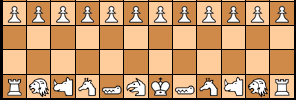
At the beginning of the game, each player has 8 grassland squares on his third rank, and eight underbrush squares on her second rank. Grass and underbrush grow one square in any direction, the same way that the King moves.In the corner is the Birch Tree, which grows the way a Rook moves. Notice that 1. Birch a1-a7 is not legal because the intervening squares a3 through a6 are not underbrush squares.
Next, on g1, b1, b8, and g8, we have the Ash Tree, which grows the way a Knight moves.
On c1, f1, f8, and c8 we find the Beech Tree, which grows the way a Bishop moves.
The Pine Tree, on d1 and d8, grows like a Queen.
The Huckleberry Bush, on e1 and e8, is a special type of underbrush: it is royal, so if you have no Huckleberry squares you have lost the game, and once per game the Huckleberry Bush can expand by leaping onto any friendly grassland square (this leap has no momentum).
Retreating
When a deciduous tree retreats or is killed or is partially killed, the squares it formerly occupied become underbrush squares. If it retreated voluntarily, these underbrush squares are owned by the player who owns the tree, but if it was killed or injured, the underbrush squares are neutral.A pine tree, when retreating or being forced back, leaves behind bare ground. In the forest, it leaves behind pine needles, which prevent most things from growing; in the game, it leaves bare ground: this is a simplification.
Underbrush retreating leaves friendly grass, and grass retreating leaves bare ground.
Moving
According to the rules of Momentum Chess, each turn, each player may move one thing or stop one thing from moving; in addition, each turn each player decides in what order his pieces should execute their moves.In this game, of course, all movement is growth, and pieces occupy multiple squares. Therefore, each turn you may start growing from any friendly square -- or, of course, you may use your turn to stop one chain of growth.
For example, suppose that your first move is to grow the Ash from b1 to d2. By momentum, the Ash would continue next move to grow from d2 to f3. However, f3 is not an underbrush square, so this growth would autostop. You could use your second move to grow your underbrush from g2 to f3, and you could choose to have the underbrush growth happen first and the Ash growth happen second -- thus the Ash would in fact continue to grow from d2 to f3.
Furthermore, the fact that a piece is already growing in one direction does not keep you from growing it in a second direction at the same time. For example, suppose you play 1. a2-a3 and then 2. Birch a1-a2; you can play 3. Ba2-b2 while momentum continues 3. Ba2-a3 -- the same piece is growing two squares per turn in different directions!
Attacking Grass and Underbrush
Grass can grow only onto bare ground, and nothing but grass can grow onto bare ground.Underbrush can grow only onto grass, and nothing but underbrush can grow onto grass. If you play 1. a2-a3, you have in effect attacked and captured your own grassland square at a3.
Trees grow only onto underbrush, and nothing but trees can grow on underbrush.
Remember that the Huckleberry Bush is merely underbrush, though it is royal.
Attacking Trees
If two or more different trees attempt to grow onto the same square in the same turn, turn, and if that square is already occupied by a tree, that square of the attacked tree is killed. [1] One of the attacking trees, at the attacker's choice, occupies the target square and retains its momentum.The tree which lost a square may also lose other squares: any square which is part of that tree but which is no longer connected to the root also dies. The vacated squares become bare ground if they were occupied by a Pine, otherwise they become neutral underbrush.
Killing the root square of a tree kills the whole tree.
In order to attack one square with two different trees, of course at least one must be growing by momentum. This makes recapture difficult.
A branch which has two connections to its root is hard to kill.
For example, suppose we have underbrush on d5, a White Beech on c4, a White Ash on d4, and a Black tree (Beech, Birch, Ash, or Pine) on e6. The move 1. Bc4-d5 threatens to capture e6, as either 2. Ad4-e6,Bd5xe6 or 2. Bd5-e6,Ad4xe6 can follow.
Mutual Annihilation
If you make a move that eliminates your last Huckleberry square you normally lose by suicide; but if that move also eliminates your opponent's last Huckleberry square, the game is a draw.
Stalemate
Stalemate is impossible unless you have very few pieces left; if you are stalemated, you lose.An impasse in the middle of the crowded board may force one player to make a retreat.
Playing The Game
It is important to grow many of your trees tall, so that you can try to attack. However, because they grow instead of moving, your trees get in each others' way!You need to grow underbrush in front of your trees so that they can advance. However, your opponent can grow her trees onto your underbrush!
If your Huckleberry occupies many squares, you may feel a bit safer. However, your trees need every square they can get!
In order to attack one square with two different trees, of course at least one must be growing by momentum. This makes recapture difficult. Therefore, once an attack starts it can be explosive.
In order to attack one square with two different trees, of course at least one must be growing by momentum. Timing is important.
Different Armies
There are many kinds of tree in the forests of the world, and who can say that a Banyan is stronger than a Mangrove or a Teak?
Philosophical Question
Do you begin the game with 8 grassland pieces, or with one grassand piece that occupies 8 squares?[1] Yes, you can kill your own trees.
Written by Ralph Betza.