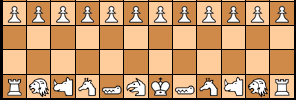
BuyPoint Chess
Basic Premise
In the opening position of Chess, each player has 31 points worth of material, not counting Pawns, and reckoning material values according to the numbers given by beginner books.The idea of Buypoint Chess is that the players start the game with a King and Pawns, and then take turns buying pieces to put on their back ranks. Of course, it would be possible for both players to choose to buy the standard chess army, and begin the game with the standard chess position.
The First Problem
If a player chooses to buy 3 Queens and a Bishop, that player has spent only 30 points. Is the extra buypoint lost, or can one buy a Pawn?Many different rules are possible, but for reasons of play balance the recommended rule is that any extra buypoints are lost.
Free-Pawns Alternate Rule
An alternate rule would be that you would start with just a King and 39 buypoints, and could have as many or as few Pawns as you want -- as long as they would all fit into your half of the board!This rule is not recommended; among other reasons, choosing to buy 27 Pawns plus four Knights would win against any other army.
Back-Rank Alternate Rule
Perhaps if you have an empty space on your back rank and have not spent all your points, you could put a Pawn there?One problem with this is that you must then choose one of the several possible rules about how and when that pawn can make a two-step move.
The Second Problem
There aren't that many combinations of 3, 5, and 9 that add up to exactly 31; that is, there are only a few shopping lists that let you spend all your points.The obvious solution to this is to put a few new items on the shelf, new items that cost just 1 or 2 buy points.
The Yawn costs one buy point, and the mAW costs two buy points.
I want to keep this simple, so that you can play it at the local Chess club. My experience with chess clubs is that you should be able to find a few mismatched or broken pieces, so it should be okay to have one or two new pieces.
If you could buy a Fibnif or a R4 (for example) instead of a Knight, a BD instead of a R, and so on, you might have trouble finding enough different pieces; and that is why the Yawn and the mAW are the only new pieces here.
The Third Problem
I myself have said that the piece-values used by beginner books aren't correct; and, look, you can buy a B or a N for the same price! And what if the new pieces aren't exactly right, what if the Yawn is worth more than one buy point or the mAW is worth more than two?The answer is: Caveat Emptor.
Seriously, the game starts with the problem of using your buy points as well as possible, so "Let the buyer beware" is a good motto.
It's also true that the value of a piece is partially determined by how well it works with the rest of its army.
Other Pieces
Well, if you really insist on being able to play with a wider range of pieces, the least I can do is give you a list of pieces and buy points.One point: The Yawn.
Two points: the mAW.
Three points: the Knight, the Bishop, the Fibnif, the Bishight, the Knishop, the Waffle, the WD, the Forfnibakking.
Five points: the Rook, the BD, the Furlrurlbakking, the Half-Duck.
Six points: any of the Augmented Knights, especially NA, ND, NW, and NF.
Seven points: the NB.
Eight points: nothing right now.
Nine points: the Queen, the Chancellor, the Forfnifurlrurking, the Forequeen.
Optional Rule
Optional rule: you can't buy another one unless you have to.This rule is easy to use but hard to explain. Perhaps the elegantly brief phrasing above is unclear.
Stated somewhat differently, if you're spending 3 points, and if either player already has a Knight, you can't buy a Knight but must buy a new piece instead -- but if all of the three-point pieces are already in the game, (in other words, if there are no new pieces to buy, because somebody already has a Bishop and a Knishop and a Bishight and a Fibnif, and so on), you have free choice.
The purpose of this rule is both to force the use of many different pieces and to introduce a new strategic element in the "buying" phase of the game. (If you like the Forfnifurlrurking, you'd better buy it before your opponent does...)