Twinkie Danger Chess
By Ralph Betza
Twinkie Danger Chess is a sweetened version of Twinkle Danger Chess with a creamy filling.Twinkie Danger Chess exists to be easy; easy to play, that is, though perhaps not easy to play well because any form of Nick Danger Chess ( not to be confused with this game by Ralph Betza, also called Nick Danger Chess) is implicitly more complex than FIDE Chess.
Rules of Twinkie Danger Chess
Rule Zero: the rules of chess apply except as follows.
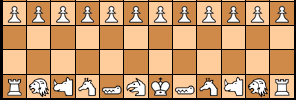
- Twinkie Danger Chess is played on two boards; at the start of the game, board 0 is exactly like the FIDE Chess board, and board 1 is empty and inaccessible.
- Starting with Black's first turn, each player makes a two-part move; the first part is a legal move (which means you must get out of check), and the second part optionally makes or breaks a link (subject to the definitions and restrictions which follow).
- Definition of link: A link turns two squares into one square, and so a piece which stands on a linked square may make any legal move available to it from either location. In other words, a piece on a linked square exists in two places at once.
- Kings and links: A King can never be on a linked square; this means that you may not link a square containing a King, and that when a King moves onto a linked square, the link is broken (and the King always stays on board 0).
-
Ownership of links:
Only the player who made a link can break it (except by moving
a King onto the square). The player who made the link owns it
in this sense, and there is a limit on the number of links a
player may own.
A link is still a link, no matter who owns it, and so any piece (except the King) can be in two places at once by moving onto a linked square no matter who owns the link.
- Making a link: Links may be made only between the same square on different boards. At least one of the two squares must be empty, neither can contain a King, and the link cannot be made if the player already owns the maximum number of links.
- Breaking a link: When you unlink an occupied square, you choose on which of the two possible squares the occupying piece remains. (But the King always stays on board 0).
- Limit: Each player may own no more than two links.
-
In the endgame, you may not make a link unless you have at least
four pieces including your King. Existing links are not broken when
you fall below this limit, but you may not make any new ones.
Opening Example of Twinkie Danger Chess
1. 0e2-0e4, 0d7-0d5/+d5Black's first move links d5 on board 0 to d5 on board 1; this example teaches the suggested notation by example.
2. 0e4x0d5/+d1
The Queen now exists on both boards, and can recapture at d5. Has White won a Pawn?
2. ... Q0d8x0d5/-d5
Black breaks the link at d5, and therefore the Qd1 can no longer capture d5.
3. Q1d1-1h5
The White Queen is now the only piece on board 1; as such, she enjoys magnificent mobility but can attack nothing directly.
Indirectly, there is a threat; I urge you to try to find it before reading further.
3. ... 0g7-0g6/+g6
Now the Black Pawn appears on g6 on board 1, attacking the Queen. In response, Qh5xg6? is a very bad idea because g6 is linked, and therefore the Q also exists at 0g6 (the square g6 on board 0), where she can be captured by 7xg6 or by f7xg6.
Note that 4. Q1h5x1g6/-g6/Q1g6 is not legal because Black owns the link at g6; that is, White might think to try capturing the Pawn, breaking the link, and leaving the Q on board 1 -- but does not own the link at g6, so that part of this idea cannot be done.
Instead, White should play
4. B0f1-0b5+/+h5
and now Qh5 defends Bb5 and attacks Qd5 and Bb5 gives check, and Black loses.
Is this a brilliant move? No, because it is really the most basic and elementary tactic characteristic of the rules of the game. If you play more than a couple of games of Twinkie Danger Chess, you will be accustomed to this sort of tactical trick.
Endgame Example of Twinkie Danger Chess
Suppose we have White King at 0c2, White Pawn at 0b2, and Black King at 0c4. If there are no links to board 1, the position is exactly like FIDE Chess, an easy draw. Remember, nobody can make a new link now because there aren't enough pieces on the board.If there is a link owned by White at b2 or at b3, White wins. No other link makes a difference.
The winning procedure is to move the Pawn onto board 1, advance it to Queen, and then use the link to return the Queen to board 0, if necessary wasting a tempo to avoid the stalemate with Qb3/Ka1. This works because White both owns and protects the link.
White wins because there is a link on a certain square. Is it luck, or foresight?
Summary of Twinkie Danger Chess
The previous article proposed an uncountable number of variants of Danger Chess, partial information with infinite boards, two boards with unlimited links, all sorts of things.Those were the sort of variants that game designers love. As long as you can claim that the game is theoretically playable, that's enough; the joy is in the rules, not in the play.
Who cares if the game is too complicated for mortals to play?
Instead, Twinkie Danger Chess is simplified, and simplified to be playable, simplified to be only a bit more complex than FIDE Chess. Twinkie Danger Chess is for the player, not the designer.
Twinkie Danger Chess is meant to be played. So, play! and enjoy!
Different Armies
The point of Twinkie Danger Chess is to make the game more simple. Playing with different armies violates the major design goal of Twinkie Danger Chess.However, the game seems to be value-preserving and therefore if you wish to play Twinkie Danger Chess with Different Armies, it should work.
Written by Ralph Betza.
WWW page created: May 23rd, 2003.